
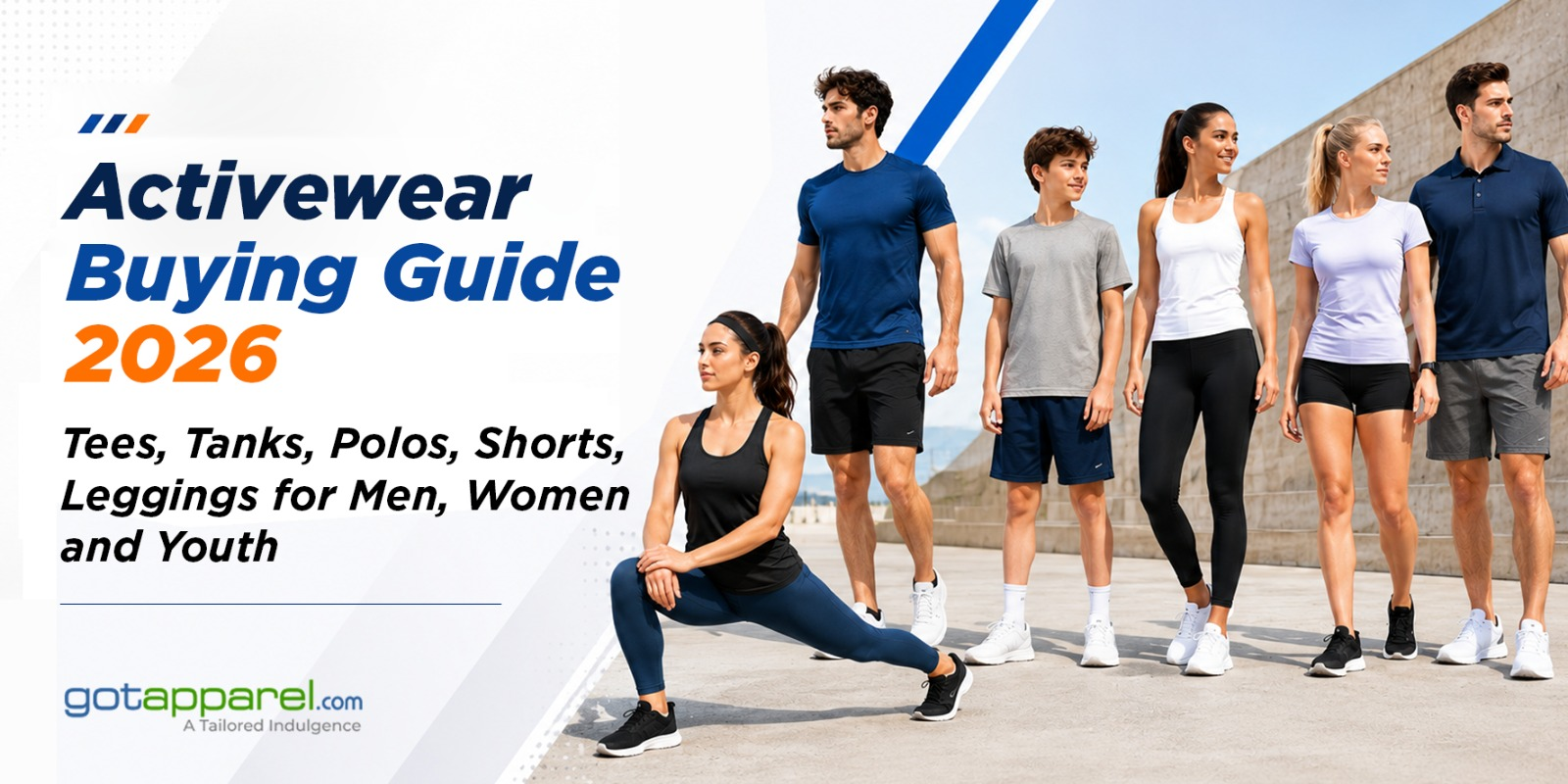
“Moisture-wicking” gets stamped on almost everything in this category, but it doesn’t mean the same thing on a 3.8 oz. race-cut tee as it does on a 6 oz. team crewneck. GotApparel carries 1500+ activewear styles across men’s, women’s and youth lines — Sport-Tek, A4, Under Armour, Adidas, Puma, Augusta, Holloway, Russell Athletic, Badger, C2 Sport, Paragon and TriDri — enough range for a single gym bag or a full team roster. After years of orders at both ends of that range, the pattern holds: buyers who check the actual fabric spec end up happier than buyers who trust the label. This guide breaks activewear down by garment, by fabric, and by what to actually buy for your situation — whether that’s five shirts for yourself or five hundred for a team.
Quick reference — everything covered in this guide: athletic t-shirts, tanks and sleeveless tops, performance polos, henleys, athletic shorts and pants, leggings and yoga pants, sports bras, youth activewear, fabric science, buying for one person vs. a team, and a brand-by-brand comparison.
Men’s and Women’s Athletic T-Shirts
Start with the A4 N3142 Cooling Performance Tee if you’re comparing wholesale gym apparel for the first time — 4 oz. 100% polyester, UPF 30-44+ sun protection, moisture-wicking, stain-release, odor-resistant, and one of the more consistently reordered performance tees in the wholesale market for exactly those specs. Sport-Tek takes a different angle with its PosiCharge line: the ST351 and ST361 Competitor/Contender styles use color-locking polyester that holds up against fading, and the ST700 Ultimate Performance Crew steps into a heavier interlock build for programs that want more structure than a basic tee offers. Gildan’s G420 Performance tee sits at the budget end, 4.5 oz., no frills, still moisture-managed — a solid pick if you just need a couple of reliable gym shirts for yourself.
Construction matters as much as fiber content. UltraClub’s 8420 Cool & Dry tee uses an interlock knit, which resists snagging under repeated athletic movement better than a plain jersey knit does. Port & Company’s PC380 Essential Performance Tee covers the same ground at a lower price point for high-volume team orders.
Women’s cuts aren’t smaller men’s shirts here — Sport-Tek’s LST307, LST340 and LST361 are built on separate women’s patterns, Port & Company’s LPC380/LPC381V match the men’s line spec-for-spec, and Bella+Canvas’s B2000/B8801 raglans bring a softer drape for programs leaning more lifestyle than strict performance.
Tanks and Sleeveless Tops
Women’s athletic tanks default to a racerback cut for a practical reason: it keeps bra straps covered through overhead movement, something a standard straight strap can’t manage. Men’s sleeveless styles split two ways — a plain cut for general wear, or a mesh-panel build that adds ventilation under the arms and across the back for higher-output training. Sport-Tek and Augusta both stock mesh-back tanks built for that second case; A4 leans lightweight across its tank line, a real advantage for track programs where every gram counts, and just as good a pick for anyone who trains or runs outdoors on their own.
Performance Polos
Swap piqué cotton for moisture-wicking polyester and the use case shifts entirely. The Adidas A230 Men’s Performance Polo is a confirmed top seller in our own catalog — 100% polyester, 14 colors, priced for corporate and team programs that want brand recognition without sacrificing function — with the A231 as its exact women’s counterpart. Puma Golf works this same territory from the course rather than the gym: built for swing mobility and moisture control during a round, and a common individual pickup for anyone who plays regularly and wants one polo that won’t soak through by the ninth hole.
For the deeper fabric-construction breakdown — piqué vs. jersey vs. mesh — that lives in our polo shirt guide. This section stays focused on the performance-fabric angle specifically.
Henleys
A henley trades the polo’s collar for a placket-front crew — usually two to four buttons — landing it between a plain tee and a polo. Port Authority’s LK750 UV Choice Pique Henley is built for exactly that gap: more finished than a tee, less structured than a polo, stretch fabric built for movement rather than sitting flat.
Athletic Shorts and Pants
Three constructions cover almost every use case. Mesh shorts move the most air and dominate basketball and general gym use. Compression shorts add a tight base layer for muscle support during high-impact movement. Woven shorts trade some breathability for a tougher shell, better suited to field sports that take a beating. One spec worth checking either way: liner construction. A built-in mesh liner lets a short work standalone without separate compression gear underneath — one less thing to pack if you’re buying for yourself, and a real cost factor once you’re ordering hundreds of units for a program.
Leggings and Yoga Pants
Four-way stretch is the baseline to check before buying leggings — it stretches and recovers in both directions, not just lengthwise, and it’s the difference between fabric that holds its shape and fabric that bags out at the knee after a few wears. Compression runs in three tiers: light for everyday wear, medium for general training, high for recovery and high-impact work. The spec people care about most but rarely see listed is opacity under stretch — anything under 6 oz. tends to go sheer at squat-level stretch, so it’s worth checking on a single pair before committing to a case of them.
Sports Bras
Most competitor buying guides skip this category outright, a real gap given how much it varies by intended use. Support splits into three tiers: low-impact for yoga and walking, medium-impact for general training, high-impact for running and HIIT. Construction follows the tier — compression-style bras use one stretch layer pressing the chest against the body, fine for lower-impact activity; encapsulation-style bras use molded cups supporting each side independently, better suited to high-impact movement at a higher price point. Band width and racerback vs. standard strap are the two other specs worth checking before ordering — sizing runs less standardized here across brands than almost anywhere else in activewear.
Youth Activewear
The same fabric logic applies to boys‘ and girls‘ lines, scaled down. Raglans, henleys and tanks see the heaviest reorders for youth sports programs, largely because a color-blocked raglan sleeve builds in team identity without a printed graphic at all. Augusta’s youth jerseys and reversible mesh styles fill that role often. Shopping for one kid rather than a roster? The same fabric picks apply — just go straight to blank items, which carry no minimum order. Outfitting a school program alongside apparel too? Our back-to-school buying guide covers that wider picture.
The Fabric Science Behind Activewear
Moisture-wicking is a two-sided fabric treatment, not a marketing label. The inner face is treated to be hydrophilic — moisture-attracting — while the outer face stays hydrophobic — moisture-repelling. Sweat gets pulled off the skin and pushed toward the outer surface, where it evaporates faster than it would through plain cotton. That mechanism is the entire reason a cotton tee and a “moisture-wicking” poly tee perform so differently under the same workout.
- 100% polyester — the standard performance fabric, 3.6-4.5 oz. typical for tees, dries fastest, takes screen printing and sublimation cleanly
- Poly/spandex blends — adds 4-way stretch, used in leggings, compression shorts, and fitted performance tees
- Interlock knit — a denser double-layer construction (UltraClub 8420, Sport-Tek ST700), more resistant to snagging than single-layer jersey
- Tri-blend (cotton/poly/rayon) — softer hand-feel, found in lifestyle-leaning pieces like Next Level’s N9000 raglan
- Mesh — open weave built for airflow, standard in basketball shorts and ventilated polos
UPF ratings are a testable number, not a vague claim: UPF 30 blocks roughly 97% of UV radiation, UPF 44+ blocks over 97.7%. Worth checking on a single running shirt or an entire outdoor team order.
Buying for Yourself vs. Outfitting a Team
Picking up a handful of pieces for personal use? Blank activewear carries no minimum order, so one tee costs the same per-unit price a bulk team order pays. Free shipping applies over $199, same-day dispatch before 3pm EST — neither requires ordering in volume.
Outfitting a team or program? Per-unit pricing drops as the order grows, sizes mix freely within one style as long as color and design stay consistent, and most brands here run steady sizing from youth through adult 5XL+, so one order can cover a full roster without splitting into several.
The fabric picks, brand comparisons, and decoration guidance below apply the same way either way. The real difference is just order size, and whether decoration comes into it.
Decorating Performance Fabric — Sublimation, DTG, Embroidery, Screen Printing
Performance polyester decorates differently than cotton, worth knowing before ordering a single custom shirt or a full team run. Sublimation is the standout method here — the dye bonds directly into the polyester fiber under heat instead of sitting on the surface, so there’s no change in hand-feel and no risk of cracking, though it needs a white or light-colored base to render color accurately. Screen printing needs polyester-compatible ink, or the print cracks under stretch. Embroidery works fine on interlock and mesh with a stabilizer backing to stop puckering. DTG is the weak link here — built for cotton, it performs poorly on synthetic fabric, so it’s rarely the right call for activewear specifically, printing one shirt or a hundred.
How to Choose by Use Case
- Everyday gym wear: The TriDri TD011 or Gildan G420 covers this whether you’re grabbing three shirts for your own rotation or ordering fifty for a fitness studio’s staff — pair with poly/spandex leggings either way.
- Outdoor sports and running: A UPF-rated tee like the A4 N3142 and a moisture-wicking tank are the right call regardless of scale — the sun doesn’t care if it’s one runner or a whole cross-country team.
- Team uniforms: Sport-Tek, Augusta, or Russell Athletic. Sizing consistency across reorders matters more here than any single style — a coach adding three kids mid-season needs the same fit as the original order.
- Corporate athletic programs: Adidas or Puma Golf performance polos, usually decorated with a company logo for staff or client-facing teams.
- Golf: The Puma Golf polo line works whether you’re outfitting a pro shop’s staff or just want one polo that holds up for eighteen holes.
- Youth sports: Augusta’s raglans and reversible jerseys are the standard pick, and youth sizing runs across most brands in this guide — the same fabric logic applies whether it’s one kid in rec league or a full travel team.
Brand Comparison for Activewear
| Brand | Signature Fabric/Line | Best For |
|---|---|---|
| Sport-Tek | PosiCharge polyester (ST350/ST351/ST700) | Team tees, budget-to-mid performance programs |
| A4 | Cooling Performance polyester (A4 N3142) | UPF-rated tees for outdoor sports |
| Adidas | 3-Stripes performance polyester (A230, confirmed top seller) | Corporate and team polos with brand recognition |
| Under Armour | HeatGear/ColdGear moisture-wicking | Premium individual and team performance wear |
| Augusta | Perfect Tri blend, moisture-wicking mesh | Team jerseys, youth sports uniforms |
| Holloway | Coolcore-style cooling tees | Cooling-technology performance tees |
| Russell Athletic | Dri-Power moisture-wicking | Team basics, reliable sizing across reorders |
| Badger | B-Core performance tee line | Budget team programs, screen printing |
| C2 Sport | Performance tee line | School and league team basics |
| Paragon | UPF rated Islander Performance tees | Warm-climate team and event programs |
| TriDri | Performance/technical tee range | Fitted athletic-cut performance basics |
| Puma Golf | Performance polo line | Golf programs and individual golfers |
Frequently Asked Questions
Is polyester or cotton better for gym shirts?
Polyester wins for actual workouts — it wicks sweat and dries faster than cotton, which absorbs moisture and stays wet. Cotton is fine for low-intensity or casual wear where breathability matters more than drying speed.
What size sports bra do I need for running?
Running is high-impact, so look for an encapsulation-style bra with molded cups and a wider band — compression-only bras are built for lower-impact activity like yoga and don’t provide enough support for running.
How many activewear shirts should a team order?
Most teams order 1-2 tees per roster spot for practice wear, plus a separate uniform piece for games — bulk pricing drops enough at higher quantities that ordering slightly extra for roster changes usually costs less than a second small order later.
What’s the difference between compression and encapsulation sports bras?
Compression bras use a single stretch layer to press the chest against the body — good for lower-impact activity. Encapsulation bras use molded cups supporting each side independently, which holds up better under high-impact movement.
What’s the best fabric for hot-weather workouts?
Lightweight 100% polyester (3.6-4 oz.) with moisture-wicking treatment and a UPF rating handles heat best — it dries fast and blocks UV, which matters as much as breathability for outdoor summer training.
Whether it’s one gym bag or a full team roster, the fabric spec is what actually determines whether activewear holds up to real use — not the logo on the tag. Reach our support team at support@gotapparel.com or 1-866-847-8678, or the decoration team at decoration@gotapparel.com / 1-866-217-1729.