
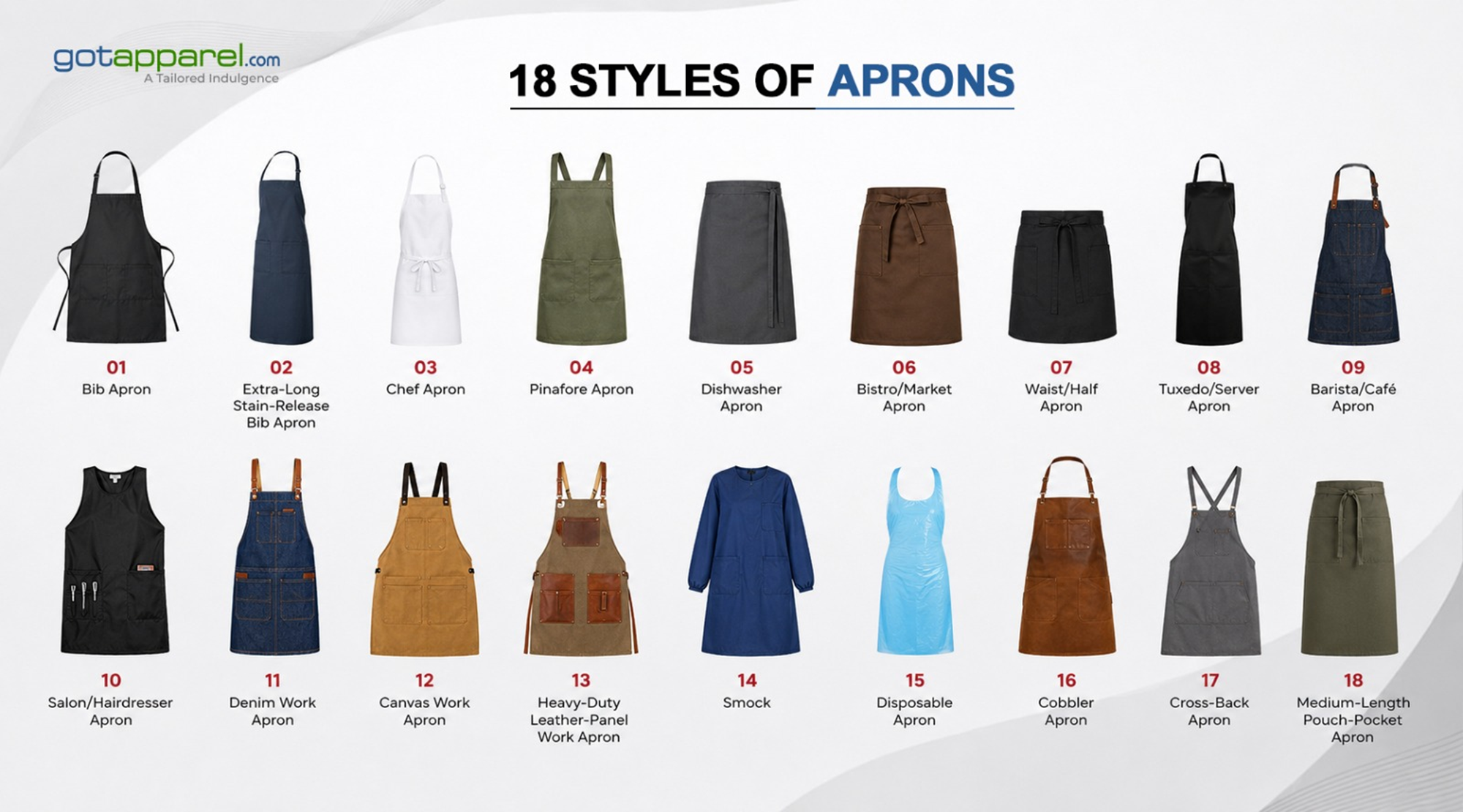
An apron’s job changes completely depending on who’s wearing it. A line cook needs full front coverage and heat protection; a barista needs to move fast between an espresso machine and a register; a woodworker needs something heavy enough to stop a splinter, not a spill. This guide breaks down 18 real apron styles by what they’re built for, so the choice comes down to your actual job, not just what’s on the first page of a search result.
The 18 styles covered: bib apron, extra-long stain-release bib apron, chef apron, pinafore apron, dishwasher apron, bistro/market apron, waist/half apron, tuxedo/server apron, barista/café apron, salon/hairdresser apron, denim work apron, canvas work apron, heavy-duty leather-panel work apron, smock, disposable apron, cobbler apron, cross-back apron, medium-length pouch-pocket apron.
How This Guide Is Organized
Rather than list all 18 in one flat sequence, this guide groups aprons by who actually wears them: kitchen and chef roles, restaurant and hospitality service, salon and personal care, workshop and trade work, medical and sanitation environments, and general utility styles that cross over between all of them. A few styles could arguably sit in more than one group — a cobbler apron shows up in kitchens and workshops both — so where that happens, it’s placed under whichever use it’s most commonly bought for.
Apron Comparison at a Glance
| Apron | Best For | Coverage | Pockets |
|---|---|---|---|
| Bib | General kitchen use | Full front | Varies |
| Extra-long stain-release bib | Heavy cooking, prep | Full front, extended | 3 front |
| Chef | Professional kitchens | Full front | Varies |
| Pinafore | Light kitchen, baking | Full front, sleeveless | Minimal |
| Dishwasher | Dish pits, wet prep | Full front, waterproof | None |
| Bistro/market | Dining service, retail | Mid-thigh to knee | 1-2 |
| Waist/half | Quick service, retail | Waist to mid-thigh | 0-1 |
| Tuxedo/server | Fine dining | Full-length, formal | 0-1 |
| Barista/café | Coffee bars, counters | Waist or cross-back | 0-1 |
| Salon/hairdresser | Salons, barbershops | Full front, water-resistant | 0-1 |
| Denim work | Coffee shops, retail branding | Full front | 1-2 |
| Canvas work | Woodworking, gardening | Full front | Multiple |
| Heavy-duty leather-panel | Welding, heavy trades | Full front, reinforced | Varies |
| Smock | Art, florists | Full body, loose | Minimal |
| Disposable | Medical, food processing | Full front | None |
| Cobbler | Kitchens, cleaning, labs | Front and back | 2-3 |
| Cross-back | High-mobility service | Full front | Varies |
| Medium-length pouch-pocket | General retail/service | Mid-length | Pouch-style |
Kitchen and Chef Aprons
Bib Apron
The bib apron is the shape most people picture when they hear the word “apron” — full front coverage from chest to knee, held up by a strap around the neck and tied at the waist. The Port Authority A600 Full-Length Two-Pocket Bib Apron is a standard, reliable version of this: enough coverage for real cooking without the bulk of an extended style. It works for home kitchens, catering setups, and any general kitchen role where nothing more specialized is needed.
Extra-Long Stain-Release Bib Apron
Take the standard bib apron and stretch the coverage down further, add a fabric treatment that resists staining, and you get the style professional kitchens actually reach for. The Port Authority A700 measures 25″w x 34.5″l in 8 oz. 65/35 poly/cotton twill with three front pockets, and it’s the most consistently reordered apron across the wholesale market — real coverage that survives a busy shift and washes clean afterward.
Chef Apron
A chef apron looks similar to a bib apron at a glance, but professional kitchens typically reach for a heavier fabric weight and reinforced stitching that a general-purpose bib apron doesn’t need. Chef Designs, one of the brands in GotApparel’s apron lineup, focuses specifically on this category, made for that environment rather than adapted from something else.
Pinafore Apron
The pinafore is a lighter, sleeveless full-coverage apron, often with a more tailored or decorative shape than a plain bib apron. It shows up more in baking and lighter kitchen prep work than in a busy line-cook environment, where the extra structure of a chef apron matters more than the pinafore’s lighter build.
Dishwasher Apron
Dish pits mean standing in near-constant moisture for hours, which rules out cotton or twill entirely — anything absorbent just gets soaked through by the second hour of a shift. PVC and vinyl solve this by not absorbing anything at all: water runs off the surface instead, and the apron gets wiped down rather than laundered between uses.
Restaurant and Hospitality Aprons
Bistro/Market Apron
A bistro apron runs longer than a basic waist apron, often to the knee, with a slightly more tailored cut that reads as “front of house” rather than “back of house.” The Port Authority A701 Easy Care Full Bistro Apron with Stain Release is a real example of this style, built for servers, market stall staff, and retail environments where the apron is part of what the customer sees, not just a work tool.
Waist/Half Apron
Where a bistro apron leans toward styled and visible, a waist apron is the shorter, more purely functional version — covering from the waist to mid-thigh, often with minimal or no pockets, built for speed and mobility rather than coverage. The Port Authority A515 Unisex Waist Apron with Pockets shows the straightforward end of this category: short, simple, made for quick-service roles where a full bib apron would just get in the way.
Tuxedo/Server Apron
This is the most formal style on the list — a longer, often black bib or waist-length apron designed specifically for fine-dining service, where the apron functions as part of the uniform rather than just protection. The Port Authority A703 Easy Care Tuxedo Apron is a real, confirmed example of this exact style, made for a dining room environment rather than a kitchen or a counter, which is the real line separating it from a barista or bistro apron.
Barista/Café Apron
A barista apron is built around standing at one station rather than moving through a dining room, so it tends to run shorter and often uses a cross-back strap design instead of a neck strap — less pulling on the neck during a long shift behind an espresso machine. The Artisan Collection RP123 Espresso Bib Apron is made specifically for this role, with a cleaner, more minimal look than a full kitchen bib apron.
Salon and Personal Care Aprons
Salon/Hairdresser Apron
A salon apron is typically shorter and made from a water-resistant or easy-wipe fabric, built to handle hair clippings, color, and product spills rather than food or grease. The coverage shape is similar to a kitchen apron, but the material has to shed hair and liquid rather than absorb it, so plain cotton twill isn’t the standard here the way it is in a kitchen.
Workshop and Trade Aprons
Denim Work Apron
Built from genuine denim rather than a plain cotton twill, this style has crossed well past its original workshop roots into coffee shops and barbershops that want a specific rugged-but-styled look. The Artisan Collection RP125 Waist Apron brings visible stitching detail and real denim construction, popular in maker-space and hospitality branding where the look matters almost as much as the durability.
Canvas Work Apron
Canvas sits between denim and leather in terms of ruggedness — tougher and more tear-resistant than denim, still breathable and washable unlike leather. Made from heavyweight canvas rather than a lighter twill, this style is meant to survive tools, sawdust, and daily wear rather than food prep, and it shows up most in gardening, woodworking, and craft-studio settings as a result.
Heavy-Duty Leather-Panel Work Apron
For trades involving sparks, heat, or sharp tools — welding, metalwork, leatherworking — a canvas apron alone often isn’t enough, and a full-leather or leather-panel construction adds puncture and heat resistance a woven fabric can’t match. Got Apparel workwear-focused brands, including Dickies and Dri Duck, cover this heavier end of the category; the Dickies AC20 Toolmaker’s Apron is a durable option here, worth confirming the exact fabric spec on before recommending it specifically for spark or heat exposure.
Smock
A smock differs from every other style on this list in one key way: it’s a full garment, not a tie-on piece, typically put on over the head with sleeves included for full-body coverage. It shows up most in art studios, florists, and grooming environments, where protection needs to extend past the torso to the arms as well.
Medical and Sanitation Aprons
Disposable Apron
Single-use by design, a disposable apron gets thrown away after one task rather than washed and reused, which keeps hygiene consistent between patients or between food-handling tasks. This matters most in environments where cross-contamination is a real risk — medical facilities, food processing lines, lab settings — and it ties directly into GotApparel’s broader Work Wear category alongside medical scrubs and lab coats for buyers outfitting a full clinical or processing team.
General Utility Aprons
Cobbler Apron
The cobbler apron covers both the front and back of the body, tying at the sides rather than just the waist — a genuinely different construction from every bib or waist style above. The Port Authority A705 and the Augusta Sportswear 2090, which despite its product name is built with the same side-tie, pouch-pocket cobbler construction, both show up across kitchens, cleaning services, and lab environments alike, because the back coverage matters wherever a worker turns and bends often.
Cross-Back Apron
A neck strap concentrates an apron’s full weight on one point; a cross-back design splits that load across both shoulders instead, using two straps that meet at the waist rather than looping the neck. It’s less a standalone apron style and more a strap configuration that shows up across other categories — most notably the barista apron — so it’s worth treating as a feature to look for rather than a completely separate garment type.
Medium-Length Pouch-Pocket Apron
Sitting between a full bib apron and a short waist apron, this style adds a large front pouch pocket instead of individual stitched pockets, made for holding a notepad, phone, or small tools without needing multiple pocket openings. The Port Authority A510 Medium-Length Apron with Pouch Pockets is a straightforward example, useful for retail and service roles that need one accessible storage spot rather than several small ones.
Fabric and Material Guide
| Material | Comfort | Durability | Care | Best Use |
|---|---|---|---|---|
| Poly-cotton twill (65/35) | High | Good | Machine washable | Kitchen, hospitality |
| 100% cotton | High | Moderate | Machine washable | Chef, pinafore styles |
| Denim | Moderate | High | Machine washable | Coffee shops, barbershops |
| Canvas | Moderate | Very high | Machine washable | Workshops, gardening |
| Leather/leather-panel | Low-moderate | Very high | Wipe clean only | Welding, woodworking |
| PVC/vinyl | Low | High (wet use) | Wipe or rinse clean | Dishwashing, wet prep |
| Poly disposable | N/A | Single-use | Discard after use | Medical, food processing |
Stain-release finishes, like the one on the Port Authority A700, are a fabric treatment rather than a different base material — they help spills wipe off before they set, but the underlying fabric weight and construction still matter most for how long an apron actually holds up.
Decorating Aprons — Embroidery, Screen Printing and Heat Transfer
Embroidery holds up to repeated washing better than a printed logo does, which makes it the standard choice for restaurant and hospitality branding programs meant to last, and it works cleanly on poly-cotton twill and denim. Screen printing suits large logo placements on flatter cotton or canvas aprons but can crack over time on heavier denim seams. Heat transfer is a solid option for smaller runs or detailed designs that don’t need to survive years of commercial washing. Disposable and PVC aprons generally aren’t decorated at all, since branding a single-use or wipe-clean garment doesn’t make financial sense. At GotApparel custom apron orders carry a 6-piece minimum, mixable across styles, with standard turnaround running 7-10 business days.
Brand Comparison for Aprons
| Brand | Known For | Best For |
|---|---|---|
| Port Authority | Bib, cobbler, bistro, tuxedo, pouch-pocket styles | Restaurants, hospitality, general kitchen use |
| Artisan Collection by Reprime | Barista, denim, cross-back styles | Cafés, workshops, craft-focused branding |
| Chef Designs | Professional chef aprons | Commercial kitchens |
| Augusta Sportswear | Cobbler-style pouch aprons | Kitchens, cleaning, lab environments |
| Dickies / Dri Duck | Heavy-duty canvas and work aprons | Trades, workshops, industrial use |
How to Choose the Right Apron for Your Role
- For kitchens: Prioritize coverage, stain resistance, washability, and heat tolerance — a busy line cook needs an apron that survives splashes and repeated washing without the fabric breaking down.
- For servers: Prioritize pockets, length, mobility, and a professional appearance — front-of-house work means the apron is part of what a customer sees, not just protection.
- For salons: Prioritize coverage, easy cleaning, and resistance to hair and product buildup — fabric that sheds rather than absorbs matters more here than raw durability.
- For workshops: Prioritize durable materials, reinforced construction, and functional pockets — canvas, denim, or leather over anything designed for washability.
- For cafés: Prioritize comfort, pockets, and a professional branded appearance — cross-back straps and a clean look matter more here than heavy-duty protection.
- For medical and food-processing environments: Prioritize consistent hygiene over reusability — disposable aprons remove laundering from the workflow entirely, which matters more than fabric quality in settings with real cross-contamination risk.
Frequently Asked Questions
What’s the difference between a bistro apron and a regular waist apron?
A bistro apron runs longer, usually to the knee, with a more tailored cut meant to be seen by customers. A waist apron is shorter and simpler, built for speed and mobility in quick-service or back-of-house roles rather than front-of-house presentation.
Do barista aprons and server aprons serve the same purpose?
Not quite — a barista apron is built for standing at one station and often uses a cross-back strap for comfort during a long shift, while a tuxedo/server apron is built for fine-dining presentation and formality in a dining room, not counter work.
What material is best for a kitchen apron?
An 8 oz. poly-cotton twill blend, like the fabric used in the Port Authority A700, is the wholesale standard — durable enough for daily use, easy to wash, and often paired with a stain-release finish for heavy cooking environments.
What’s the difference between a smock and an apron?
A smock is a full garment worn over the head with sleeves for full-body coverage, while an apron ties on and typically covers only the front of the body, leaving the arms exposed.
Why would someone choose a disposable apron over a washable one?
Disposable aprons keep hygiene consistent between tasks in medical or food-processing settings where cross-contamination is a real concern, and they remove laundering entirely from a busy team’s workflow.
Whether it’s one apron for a home kitchen or a full staff order across a restaurant, salon, or workshop, the right style comes down to matching the coverage and fabric to the actual work, not just the look. Reach our support team at support@gotapparel.com or 1-866-847-8678, or the decoration team at decoration@gotapparel.com / 1-866-217-1729.