
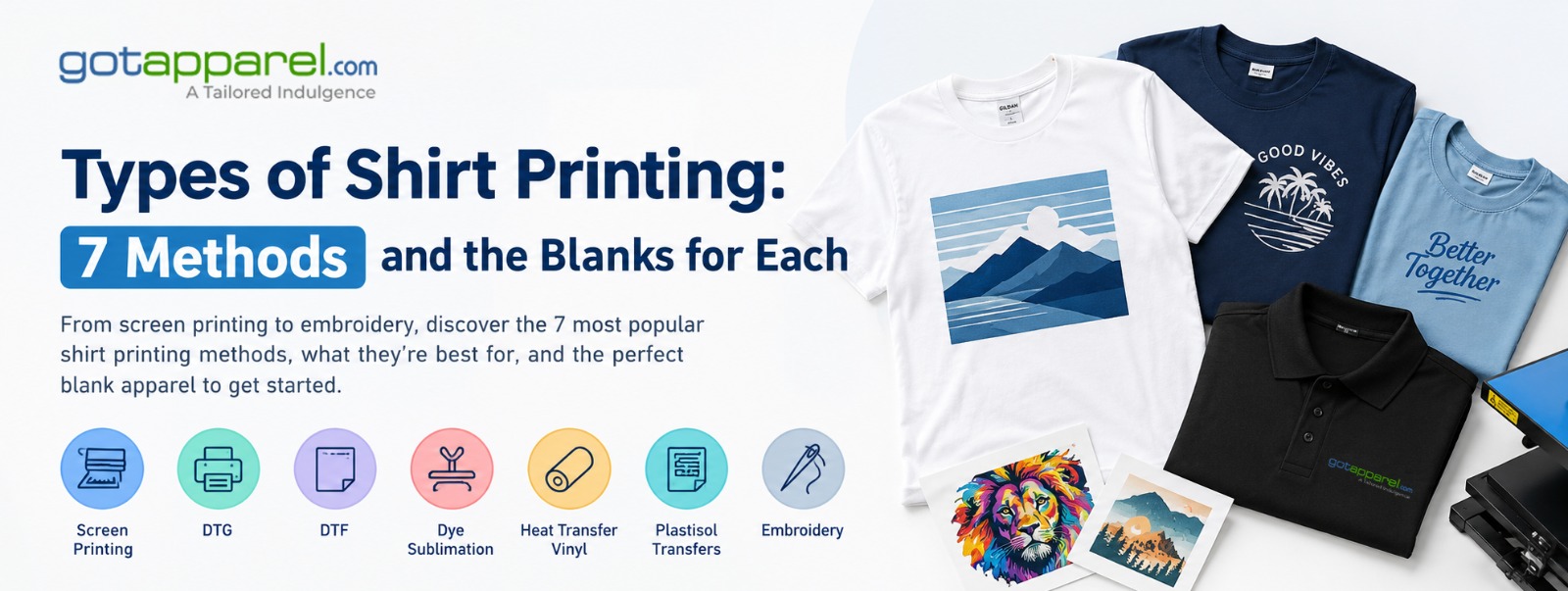
The main types of shirt printing, also called t-shirt printing methods, are screen printing, direct-to-garment (DTG), direct-to-film (DTF), dye sublimation, heat transfer vinyl, plastisol transfers and embroidery, which uses thread instead of ink. A logo that looks sharp on one shirt can crack on another, vanish on a dark color, or feel like a sticker after a few washes, so the shirt matters as much as the method.
GotApparel has supplied blank apparel since 2007 and carries more than 8,500 products from over 160 brands, so the blanks named below come from a working catalog. For each method you’ll see what it does well, where it struggles, and a blank or two that suits it.
What this guide covers: the 7 methods, a few specialty finishes, which fabrics work with which method, how to choose, printing beyond t-shirts, and care tips.
Shirt Printing Types at a Glance
| Method | Best For | Works On | Print Feel | Blanks to Start With |
|---|---|---|---|---|
| Screen Printing | Bold, few-color designs | Cotton and blends | Slightly raised | Gildan G500, Comfort Colors 1717 |
| DTG | Detailed, full-color art | 100% cotton | Soft | Comfort Colors C1717, Bella+Canvas 3001 |
| DTF | Full color on mixed fabrics | Cotton, polyester, blends | Thin layer on top | Gildan G800, Sport-Tek ST350 |
| Dye Sublimation | Colorful graphics on performance wear | White or light polyester | No texture | Sport-Tek L474 |
| Heat Transfer Vinyl | Names, numbers, simple logos | Cotton, polyester, blends | Raised, can feel rubbery | Sport-Tek ST350, Gildan G500 |
| Plastisol Transfers | Repeat designs in batches | Cotton and blends | Slightly raised; feel varies by design | Gildan G500, Gildan G800 |
| Embroidery | Logos and short text | Polos, caps, jackets | Stitched, textured | Port Authority K500 |
The 7 Types of Shirt Printing
Screen Printing
Screen printing is the method most people picture: ink is pushed through a fine mesh stencil onto the shirt, one screen for each color, and then heat-cured. Because every color needs its own screen, setup takes time, but once the screens are made each extra shirt goes quickly. That makes it the usual choice for bold, few-color designs on team, event and business orders. The ink sits on the fabric with a slightly raised feel, and when properly applied and cured, screen prints hold up well through repeated washing. It’s a poor fit for a single shirt or a photograph. The Gildan G500, a 5.3-oz. heavy cotton tee, is a dependable starting point, and the Comfort Colors 1717 suits designs that call for a softer, heavier shirt.
Direct-to-Garment (DTG) Printing
DTG works much like an inkjet printer for fabric. Water-based ink is printed directly onto the shirt, so there is no screen setup for each color. That makes DTG useful for detailed, full-color artwork and short runs, including orders where every shirt has a different design. It looks best on 100% cotton, where the ink soaks into the fibers for a soft finish, and dark shirts need a pretreatment step first. Durability varies with the ink, pretreatment, curing and care, and screen printing is often the practical choice for repeated bulk production. Try the Comfort Colors C1717 or the Bella+Canvas 3001, both ring-spun cotton.
Direct-to-Film (DTF) Printing
DTF prints the design onto a clear film, dusts it with adhesive powder, and presses it onto the shirt with heat. Since the design sits on the surface as a thin layer, it works on cotton, polyester and blends, and colors stay bright on dark shirts. The trade-off is feel: the print rests on top of the fabric, so it reads a little heavier than DTG. It’s a sensible middle path for mixed fabrics. Polyester garments may need a compatible transfer and controlled pressing conditions to reduce dye migration, so test the exact garment before a full order. The Gildan G800, a 5.5-oz. 50/50 blend, and the Sport-Tek ST350, a 3.8-oz. polyester performance tee, are good bases.
Dye Sublimation
Sublimation turns special dye into a gas under heat, and the gas bonds with polyester fibers, so the color becomes part of the fabric instead of sitting on it. With no separate ink layer, the print has no texture and there is nothing to crack or peel, which makes it a strong match for performance shirts and colorful graphics. The limits are firm: it works only on Polyester fabric or a garment specifically designed for sublimation, and the dye is transparent, so it shows on white or light colors, not dark ones. The printable area depends on the equipment, and all-over designs that cross seams usually require printing the fabric before the garment is sewn. The Sport-Tek ST350, a 100% polyester tee, is a common base; print a test shirt in the exact color you plan to order.
Heat Transfer Vinyl (HTV)
Heat transfer vinyl starts as a sheet of colored vinyl. A design is cut from it and pressed onto the shirt with heat. Edges come out crisp and each color is a solid, which is why HTV is excellent for names, numbers and simple logos, including a different name on every shirt in one order. It isn’t suited to gradients or detailed art, and large solid areas can feel stiff and rubbery. The Sport-Tek ST350 suits team and activity shirts, and the Gildan G500 covers everyday cotton tees.
Plastisol Transfers
Plastisol transfers are designs screen printed onto special paper, then pressed onto the shirt later. Because the transfers can be made ahead of time, they suit designs that are needed in batches or on demand. The finish is slightly raised and can be very durable, though a sample is worth checking for a faint edge around the artwork. They differ from at-home iron-on paper, which is fine for a one-off but generally less durable than professionally made transfers. The Gildan G500 and G800 both take transfers well.
Embroidery
Embroidery uses thread instead of ink: the design is stitched into the shirt, which gives it a textured, polished look. Stitched logos can withstand frequent laundering when the thread, garment and stitching suit the job, which is why they’re common on polos, caps and jackets. They suit logos and short lines of text best, since fine detail, gradients and very small lettering don’t stitch well, and thin or very stretchy fabrics can pucker. The Port Authority K500 polo, a 5-oz. 65/35 poly/cotton pique, is a classic base.
Specialty Finishes
Some popular terms are variations on the methods above. Discharge printing, a screen printing technique, removes dye from dark cotton and replaces it with color, giving a soft, vintage feel. Puff printing uses an ink that expands under heat for a raised look. Foil, glitter and reflective finishes add shine or visibility to screen printed or transferred designs. Water-based and plastisol are ink types: water-based ink soaks in for a softer feel, while plastisol sits on top and covers dark shirts more opaquely.
Which Fabric Works With Which Method
The shirt decides more of the result than people expect. Start with the fabric:
| Fabric | Works Well With | Be Careful With |
|---|---|---|
| 100% cotton | Screen printing, DTG, DTF, vinyl, transfers, embroidery | Sublimation, which needs polyester |
| Polyester | Sublimation (light colors), DTF, vinyl | Standard DTG works best on cotton or cotton-rich fabric, so polyester depends on the printer and process; dye migration can also affect light-colored prints, so test first |
| Cotton/poly blends | Screen printing, DTF, vinyl, embroidery | DTG, which looks best on high-cotton shirts, and sublimation, which needs mostly polyester |
| Garment-dyed cotton | Screen printing, DTG, embroidery | Dye-lot variation and pretreatment can affect results, so test a sample when color consistency matters |
Color changes the job too. Dark shirts add steps for several methods, and conventional sublimation is unsuitable on them because the dye is transparent. Light shirts are the easy case for almost everything. Weight matters as well: heavier fabrics tend to carry embroidery cleanly, while thin ones can pucker.
How to Choose a Method
Start with four questions. How many shirts do you need? A bold logo on a few dozen or more often points to screen printing, detailed art on a handful often points to DTG or DTF, and names and numbers for a small team often point to vinyl. What does the artwork look like? A few solid colors suit screen printing or vinyl, photos and gradients need DTG, DTF or sublimation, and a logo for a polo or cap is an embroidery job. What is the fabric? The table above settles most of this. And how long does it need to last? Durability depends on the application and care, but embroidery and well-cured screen printing are often the most durable choices on cotton and blends.
Embroidery, screen printing, heat transfer and DTG are available through our decoration team. Custom decoration has a 6-piece minimum per design, with styles mixable where applicable, and decorated pricing steps down as quantities rise. Standard decoration takes 7 to 10 business days once your design is approved. Decorated orders are final sale, so review the design carefully before approving it.
Printing Beyond T-Shirts
Methods behave differently on thicker garments. Fleece sweatshirts and sweatpants, such as the Gildan G182 (an 8-oz. 50/50 sweatpant), usually take screen printing well, with the leg and hip as common placements. Polos shirt, Headwear and Outerwear are natural for embroidery. Workwear suits embroidery too, because stitching can stand up to repeated commercial laundering; sturdy twill like the Dickies P874 work pants, an 8.5-oz. polyester-cotton, is a typical base. Performance fabrics are usually polyester, so sublimation, DTF or vinyl suit them better than DTG.
Caring for Printed Shirts
Turn the shirt inside out, wash it in cold water, and tumble dry low or hang it up. Skip bleach, and don’t iron directly on a print or vinyl. High heat is the quickest way to shorten the life of vinyl and transfer prints.
Frequently Asked Questions
Which is better, DTG or DTF?
Neither wins every time. DTG gives a softer print on 100% cotton, while DTF works on cotton, polyester and blends and stays bright on dark shirts. Choose DTG for cotton tees and DTF for mixed or synthetic fabrics.
Which type of printing is best for shirts?
It depends on the order. Screen printing suits bold designs in bulk, DTG suits detailed art in small runs, and embroidery suits polos and caps. Match the method to the design, fabric and quantity.
What is better, DTF or screen print?
Screen printing is usually better for large orders of simple designs, because the cost per shirt drops with volume. DTF is better for full-color art, small runs and non-cotton fabrics, since it needs no screens.
What type of shirt printing lasts the longest?
It depends on the method, the garment and how it’s washed. Properly cured screen printing and embroidery are often the most durable on cotton and blends, and sublimation is very durable on suitable polyester.
Can you print on polyester shirts?
Yes. Dye sublimation, DTF and heat transfer vinyl all work on polyester. Standard DTG works best on cotton or cotton-rich fabric, so it’s the weakest fit.
Is there a minimum order for custom shirt printing?
Custom decoration at GotApparel has a 6-piece minimum per design, with styles mixable where applicable. Blank shirts can be ordered by the piece, apart from a few styles sold only with customization.
If you’re choosing between methods for a team, a store or an event, tell us the garment, the quantity and the artwork, and our decoration team will point you to a good fit. Reach our support team at support@gotapparel.com or 1-866-847-8678, or the decoration team at decoration@gotapparel.com 1-866-217-1729.