
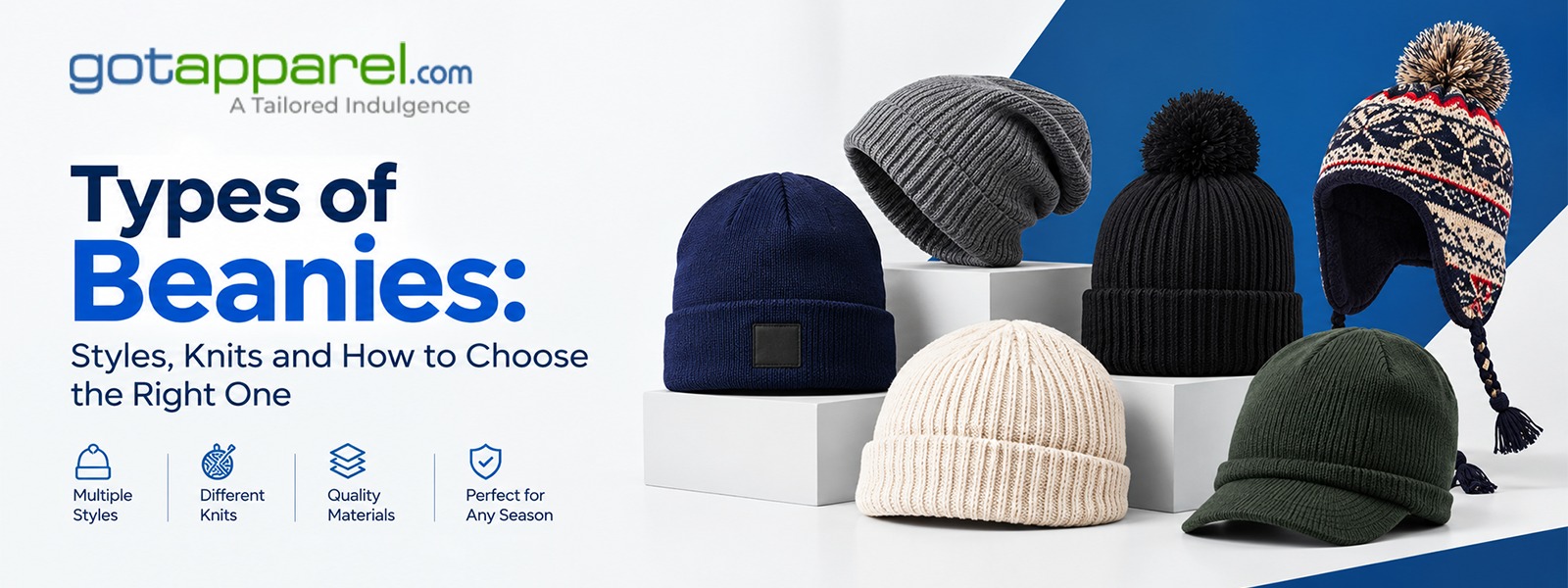
A beanie is usually a close-fitting knit hat without a brim, though hybrids like the visor beanie add a short one. Beyond that, the differences that matter are smaller: how long the knit runs, whether there’s a cuff, how tall the crown is, and how much of your ears it covers.
This guide covers ten recognizable beanie styles, then looks at the knits, materials and features that change how they feel. GotApparel has supplied blank and custom apparel since 2007, and our beanie collection runs to more than 100 styles from over 20 brands including Port Authority and Richardson, most of them under $8. The examples below come from what we actually stock.
Beanie Types at a Glance
| Type | Fit and length | Ears | Good for |
|---|---|---|---|
| Cuffed | Snug, with a folded band | Covered | Everyday wear, mixed teams |
| Cuffless | Snug, single layer | Covered | Layering under hoods |
| Skull cap | Short and tight | Mostly covered | Helmets, runs, work |
| Fisherman | Short, rolled cuff | Partly open | Casual, low-key style |
| Slouchy | Loose, extra length | Covered | Longer hair, relaxed looks |
| High-top | Tall, upright crown | Covered | Bold style |
| Pom | Usually cuffed, ball on top | Covered | Team colors, game days |
| Earflap | Snug, with side flaps | Fully covered | Cold, breezy days |
| Visor | Snug, with a short brim | Covered | Sun glare, snow, outdoor work |
| Ponytail | Snug, with an opening | Covered | Winter workouts |
The Main Types of Beanies
Cuffed Beanie
Most people picture this one first. The folded band lets you set your own fit: roll it up for a short, snug look or pull it down for more coverage. The Yupoong 1501 Unisex Cuffed Knit Beanie comes in more than 15 colors, and the Bayside 3825 Unisex Knit Cuff Beanie is another simple, budget-friendly pick.
Cuffless Beanie
This is a single layer of knit with no fold. It’s lighter, sits flatter under a hood or collar, and is the more comfortable choice indoors or on milder days. You can wear it long, or fold it once if you want the cuffed look. The Yupoong 1500 Unisex Knit Beanie is the classic version, offered in more than a dozen colors.
Skull Cap
Short, snug and low-profile, a skull cap usually stops around the ears and hugs the head, though some run longer. That slim shape slips under a helmet, hard hat or hood without bunching, which is why cyclists, runners and outdoor crews reach for it. Thin versions work best as a layer, while thicker ones can handle cold on their own. The Port & Company CP94 Men Knit Skull Cap is a simple example: a stretchy acrylic knit that comes in three colors.
Fisherman Beanie
Short with a rolled cuff, it often sits at or just above the ears. That leaves the ears partly open, so it’s a style choice more than a warmth choice. It’s often sold as a docker beanie, though brands don’t use the names the same way. The traditional watch cap is a related rolled-cuff knit, usually worn lower over the ears. A fisherman beanie looks clean with a jacket collar and suits people who want a hat without much volume.
Slouchy Beanie
Extra length gathers at the back of the head, so the hat hangs loose and doesn’t press your hair flat. Oversized and long beanies belong in this group too. Thicker or ribbed knits tend to hold the slouch best, while very thin ones can sag. The BAGedge BA519 Slouch Beanie and the District DT618 Slouch Beanie both show the relaxed fit.
High-Top Beanie
The crown stands upright instead of drooping, and a thick, ribbed knit usually holds that shape. It adds a little height to an outfit, so it’s more about looks than function.
Pom Beanie
A ball of yarn or faux fur sits on top, usually on a cuffed body. The extra height won’t fit under a helmet, but it’s a natural choice for team colors or a seasonal look, and striped or multi-color versions are common. Take a look at the Sport-Tek STC21 Pom Team Beanie, the Pacific Headwear 641K Knit Fold Over Pom-Pom Beanie, and the BAGedge BX028 Knit Pom Beanie.
Earflap Beanie (Chullo)
Side flaps hang over the ears, and some styles tie under the chin. They add coverage where cold and wind hit hardest, though how well they hold up still depends on the fabric. The Andean chullo is a traditional earflap hat, often decorated with colorful geometric patterns. Earflaps add bulk, so they don’t pair well with hoods.
Visor Beanie
A short brim at the front shades your eyes from low sun and snow glare. It’s a cross between a knit hat and a cap, and it suits skiing, hiking and outdoor work. A snug fit helps the brim stay put in wind.
Ponytail Beanie
An opening at the back or top lets a ponytail or bun pass through, so the hat doesn’t crush your hair. The opening also lets a little heat escape, which helps during runs and winter workouts.
Knits and Features That Change a Beanie
These details sit on top of the styles above. They change how a beanie feels, how warm it is, and how it looks.
Fleece-Lined and Fleece Beanies
A fleece lining inside a knit shell adds insulation and feels softer on skin that finds wool scratchy. It doesn’t make a hat windproof, since that depends on the outer knit, but it does make cold days more comfortable. The Port Authority C922 Unisex Fleece-Lined Striped Beanie Cap is a good example. Beanies made entirely from fleece are a lighter alternative. Look at the Port Authority C918 Men Fleece Beanie and the C900 Men R-Tek Stretch Fleece Beanie, which comes in seven colors.
Cable Knit
Twisted, raised stitches make a thicker, textured fabric. How warm it is depends on the yarn and how dense the knit is, but the added thickness often helps. The Atlantis Headwear SHORE is a cuffed cable knit, 11 inches long and 7 inches wide. It comes in ten colors and is listed as a 50/50 recycled polyester and acrylic blend, which makes it a candidate for sustainability-minded programs.
Rib Knit
Vertical ribs stretch and spring back, so the hat hugs the head and keeps its shape after repeated wear. The BAGedge BA524 Ribbed Marled Beanie adds a two-tone, marled look on top of the ribbing.
Waffle Knit
A grid texture adds a little loft and traps a thin layer of air. It looks tidy with or without a cuff. The Richardson 146R Waffle Cuffed Beanie is a clear example.
Camo and Patterned
Camo, stripes and plaid change the look without changing the shape. Our Kati LCB08 and LCB12 are camo knit caps in Realtree and Mossy Oak patterns, with a cotton/polyester knit and an acrylic lining. The LCB08 is an 8-inch knit that sits shorter, while the LCB12 runs 12 inches and covers more of the head.
Hi-Vis and Reflective
Bright colors and reflective trim help crews stay visible in low light, which matters for roadside, warehouse and winter work. The CornerStone CS800 Enhanced Visibility Beanie has a reflective stripe, and the BAGedge BA535 is a women’s style with reflective trim.
Beanie Materials and Linings Compared
| Material | Feels | Best for | Watch for |
|---|---|---|---|
| Acrylic | Soft and light | Everyday wear, teams, tight budgets | Can pill over time |
| Wool | Warm and breathable | Cold, active days | Can itch, needs gentle washing |
| Merino wool | Finer and softer than wool | Skin that finds wool scratchy | Higher price |
| Cotton | Light and breathable | Mild weather | Less warm, especially when damp |
| Fleece lining | Soft inside, adds insulation | Outdoor work, cold commutes | A little bulkier |
| Recycled blends | Feel varies by blend | Sustainability programs | Ask what the recycled claim covers |
Warmth depends on the whole hat, including the fiber, thickness, knit and lining, and not on any one of them. Acrylic is the fabric listed most often in our beanie collection and the usual starting point for team and promotional orders. If cotton suits your climate, the Port Authority CP95 Men 100% Cotton Beanie is a light, breathable option. For an organic option, look at the Econscious EC7040 Women Organic Beanie.
What Else Is a Beanie Called?
The name depends on where you are. In Canada it’s usually a toque, and in the UK a woolly hat, or a bobble hat when there’s a pom on top. Parts of the US say stocking cap, some Southern regions say toboggan, and military and workwear circles say watch cap. Usage overlaps, so treat these as tendencies and not strict rules.
How to Choose a Beanie
- Cold: fleece-lined, thick cable-knit or earflap styles. For wind, check the outer fabric. On mild days, a cotton or thin acrylic cuffless beanie is plenty.
- Activity: a skull cap under helmets and hoods, a visor beanie for sun and snow, a ponytail style for runs.
- Length: this tells you more than any label. Shorter styles sit above the ears and longer ones pull down over them, so check the measurements on the product page.
- Size and fit: nearly all of our beanies are one-size and the knit stretches to fit most heads. Men’s and women’s labels mostly reflect colors and styling.
- Teams and events: a one-size cuffed or cuffless acrylic beanie fits a mixed group, takes color well and keeps the cost down.
Decorating Beanies With Your Logo
Embroidery is the usual choice for knit hats. The fabric stretches and has texture, so simple logos with bold shapes look cleanest, and very small text tends to disappear into the knit. At GotApparel, designs over about 10,000 stitches carry an additional fee, so a simpler logo also costs less.
Placement matters. On a cuffed beanie, the front of the cuff is a flat, steady band. On cuffless and slouchy styles the logo sits on the knit itself, so ribbed, waffle or cable texture can soften fine detail. Options differ by style: the camo and cable-knit styles list center-front embroidery, while the Port & Company CP94 skull cap adds side and back positions.
Patches are the other route, especially for detailed logos. A woven or leather patch is stitched on, so the artwork stays sharp whatever the knit. Screen printing can be harder on stretchy knit, so embroidery or a patch is usually the safer choice. At Got Apparel, custom decoration starts at six pieces per design and styles can be mixed. Confirm placement and logo size for your exact beanie with our decoration team before you order.
Choosing beanies for a team or an event? Our support team is at 1-866-847-8678 or support@gotapparel.com, and our decoration team can help with styles, placement and logo size at 1-866-217-1729 or decoration@gotapparel.com.
Beanie FAQs
Is a beanie a type of hat?
Yes. It’s a hat, specifically a close-fitting knit one, usually without a brim. Baseball caps, bucket hats and fedoras are different because they have a brim and a stiffer crown.
What are baggy beanies called?
Slouchy beanies, which shops also list as oversized or long beanies. They’re cut with extra fabric so they hang loose instead of hugging the head.
What is the most popular type of beanie?
The cuffed beanie is generally the most common, mainly because it fits most heads and suits most outfits. Slouchy and fisherman styles are the usual alternatives.
What is the difference between a beanie and a skull cap?
A skull cap is a close-fitting beanie, usually without a cuff, that sits snug to the head and often stops near the ears. Other beanies tend to run longer and may add a cuff or slouch.
What yarn is best for beanies?
It depends on the job. Acrylic is the easy-care everyday pick, merino is the soft, warm one, and cotton suits mild weather. A fleece lining adds comfort when it’s cold.
Which beanie suits men with longer hair?
A slouchy beanie usually works best, since the extra length leaves room at the crown so your hair isn’t pressed flat. A ponytail beanie is another good option if you tie your hair back.
Can beanies be washed?
Most acrylic beanies can go through a cold machine wash and air dry. Wool and merino do better washed gently by hand. Check the label, since linings and trims can change the care.
What is the warmest type of beanie?
Thick wool or merino beanies and fleece-lined styles can provide substantial warmth, depending on their construction and thickness. For windy conditions, check the outer fabric and consider an earflap style for additional ear coverage.