
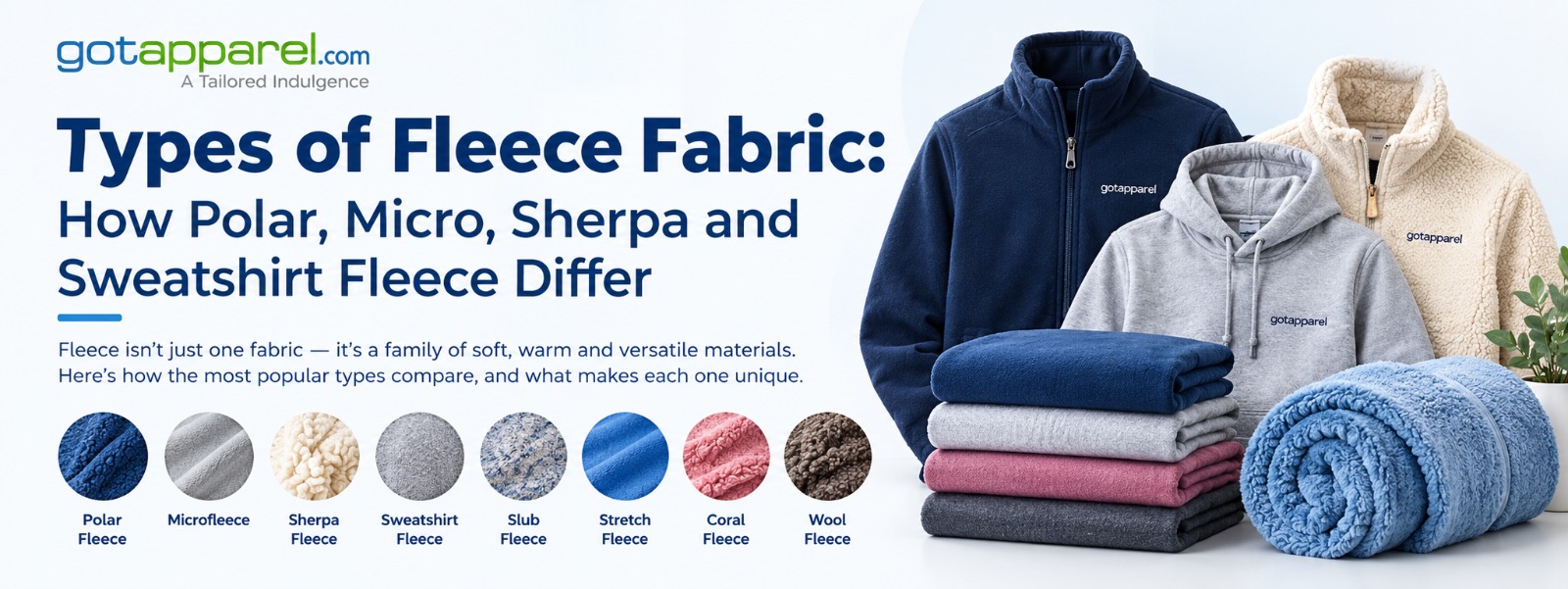
Fleece isn’t one material but a family of soft, lofty fabrics. What they share is a napped or pile surface that traps warm air, and what sets them apart is the fiber (usually polyester, sometimes a cotton blend, historically wool), how that surface is made, and how heavy the fabric is. That’s why the word can describe a warehouse crew’s plush jacket, a school’s spirit-wear hoodie and a velvety throw blanket, three things that feel nothing alike.
You’ll hear fleece described by its fiber, its surface, its construction and its brand name, often all at once, so no two guides count the types the same way. This one walks through the eight you’re most likely to meet, then the close relatives that get mistaken for them. GotApparel has supplied blank and custom apparel since 2007, and the styles mentioned come from our catalog, which includes more than 150 men’s and more than 100 women’s fleece jackets from brands like Hanes, Gildan, Port Authority, Spyder, Core 365 and more.
Fleece Fabric at a Glance
| Type | Fiber | Feel | Weight |
|---|---|---|---|
| Polar fleece | Polyester | Fuzzy on both faces | Mid to heavy |
| Microfleece | Polyester | Fine, smooth, short pile | Light |
| Sherpa (boa) | Polyester | Curly pile on one face | Mid to heavy |
| Sweatshirt fleece | Cotton or cotton/poly | Smooth outside, brushed inside | Mid to heavy |
| Slub fleece | Usually cotton/poly | Flecked, heathered | Mid |
| Stretch fleece | Fleece with spandex | Soft, with give | Light to mid |
| Coral fleece | Polyester | Dense, velvety | Light to mid |
| Wool fleece | Wool | Natural, springy | Varies |
The Types of Fleece Fabric
Polar Fleece
The fabric most people mean by “fleece” Polar fleece is polyester brushed on both faces, soft inside and out with a springy loft. It dates to the 1970s, when Malden Mills (now Polartec) set out to imitate the loft of wool with man-made fibers. Weights run mid to heavy, and “blizzard fleece” is generally described as a thinner, more pliable version of the same fabric. Compare the Port Authority F217 Value Fleece Jacket (L217 for women), offered in many colors and extended sizes, with the Harriton M990 8 oz Full-Zip, a plainer, lower-priced option for uniform budgets.
Microfleece
Microfleece is the lean version: finer yarns, a short pile and a smooth hand, generally up to about 200 gsm (close to 6 oz). It breathes, dries fast and slips under a jacket without bulk, which makes it a favorite for layering and for mild days. The trade-off is insulation, so it won’t carry you through a long January shift outdoors. The Port Authority F223 jacket and F224 quarter-zip show the category well.
Sherpa Fleece (Boa)
Sherpa, also sold as boa fleece or faux shearling, is built to resemble sheep’s wool. One face is a flat knit and the other carries thick, curly pile. It’s usually all polyester, and that plush surface gives it a cozy, slightly retro look, so it appears more often as a lining, collar or statement piece than as a daily uniform layer. For apparel, look at the Spyder S17940 Venture Sherpa Jacket, which bonds polyester sherpa to a stretch nylon shell; for something to wrap up in, the Port Authority BP48 Double-Sided Sherpa/Plush Blanket.
Sweatshirt Fleece
This is the fleece that hides in plain sight. Sweatshirt fleece is a cotton or cotton-polyester knit with a smooth, jersey-like face and a soft, brushed interior, so a hoodie can feel cozy while looking like an ordinary knit. It runs heavier than polyester fleece, commonly around 7 to 10 oz, and its flat face takes screen printing readily, making it a frequent choice for school and club orders. Two names that come up in nearly every blank-apparel conversation are the Gildan G185 Heavy Blend hoodie and the Hanes P170 EcoSmart 50/50 hoodie.
Slub Fleece
Slub fleece is made from yarn that varies in thickness along its length, which gives the fabric small flecks and a heathered, slightly textured look. It’s often a cotton-polyester blend; the Port Authority F295 Slub Fleece 1/4-Zip Pullover, for instance, is a 9 oz 65/35 cotton/poly with a brushed interior. The look is more relaxed than plain polar fleece yet polished enough for business-casual quarter-zips, and the Port Authority L293 is the women’s full-zip. (Burnout fabrics are a different process: parts of the fiber are chemically removed to create a pattern.)
Stretch Fleece
Stretch fleece folds a little spandex (often sold as Lycra) into the knit, so the fabric gives when you move and springs back afterward. That recovery matters where fit does: fitted layers, performance jackets, and accessories such as beanies and headbands that must hug without bagging out. Port Authority’s Accord Stretch Fleece Full-Zip (K595 for men, LK595 for women) is a tidy example, and the R-Tek Stretch Fleece Beanie C900, applies the same idea to headwear.
Coral Fleece
In apparel and home textiles, “coral fleece” usually means a plush, velvety polyester with a short, dense pile, though the exact construction varies by supplier. Softness is the whole point, so it lives mostly in blankets, robes and loungewear. The Alpine Fleece 8707 Micro Coral Fleece Blanket, a lightweight 50 x 60-inch throw in 100% polyester, is a representative piece.
Wool Fleece
Fleece began as the word for a sheep’s woolly coat, and “wool fleece” can still mean that raw, unprocessed coat. It can also describe a wool fabric with a fleecy surface. Either way, it’s a specialty material: most fleece in team, school and workwear orders is polyester or a cotton blend, so there’s no catalog style to point to here. It earns its place because the question comes up so often.
Fleece Fabrics Compared
| Comparison | The main difference |
|---|---|
| Polar fleece vs. microfleece | Polar has a fuller pile and more insulation; microfleece is thinner, lighter and easier to layer. Actual warmth also depends on weight and construction. |
| Sherpa vs. polar fleece | Sherpa has a curly, wool-like pile and suits plush linings and cozy garments; polar fleece has a more even fuzzy surface and is the practical layering workhorse. |
| Sweatshirt fleece vs. French terry | Sweatshirt fleece has a brushed interior; French terry keeps unbrushed loops inside, so it feels cooler and lighter. |
Related Constructions and Finishes
These names often appear next to fleece on a label, but they describe a knit, a construction or a finish, not a separate fabric.
French Terry
French terry is a knit, usually cotton or a cotton blend, that’s smooth outside and looped inside. Because the loops are left unbrushed, it runs cooler and lighter than sweatshirt fleece, and it’s often filed alongside fleece, so the two get confused. The Sport-Tek ST273 Lightweight French Terry 1/4-Zip Pullover, a 6.5 oz cotton/poly French terry, is a handy reference. (Terrycloth, the towel fabric, is another thing again.)
Bonded Fleece
Bonded fleece is a fleece layer laminated to a woven or knit shell, so the outside resists wind while the inside stays soft. It’s the fix for anyone who wants fleece warmth but has to stand in a breeze, as with the Core 365 88184 Cruise Two-Layer Fleece Bonded Soft Shell Jacket. Brand names such as R-Tek, Therma-Tek and Tech Fleece label particular builds, so the fabric line on the product page tells you what’s inside.
Grid Fleece
Grid fleece has a pattern of raised and recessed channels, often described as waffle-like, in place of a uniform pile. The channels keep it light and help it breathe and move moisture, so it’s popular for active layers and outdoor mid-layers. Names vary by brand, so confirm the construction on the product page.
Anti-Pill Fleece
Anti-pill describes fabric construction, yarn selection and/or finishing treatments designed to reduce pilling, the tiny fuzz balls fleece can develop from friction. It isn’t a separate fabric, but for uniforms that need to look sharp all season, it’s worth asking for by name. The Port Authority F223 microfleece jacket, for example, is described as having an anti-pill finish. Washing cool on a gentle cycle, turning garments inside out, skipping fabric softener and drying on low heat or hanging help any fleece last longer.
Fleece Weight Explained
Weight appears as ounces per square yard or grams per square meter (gsm), and one ounce is roughly 34 gsm. The ranges below are approximate.
| Class | gsm | Ounces | Typical use |
|---|---|---|---|
| Lightweight | About 100 to 200 | About 3 to 6 | Layering, mild weather |
| Midweight | About 200 to 300 | About 6 to 9 | Everyday jackets and pullovers |
| Heavyweight | 300 and up | About 9 and up | Cold-weather work, thick polar and sherpa |
Compare within the same fiber: a 9 oz cotton-blend hoodie and a 9 oz polyester jacket won’t feel alike, and a heavier fabric isn’t automatically warmer. Pile height, density, garment construction and a windproof layer all play a part.
Choosing Fleece for the Job
- Warehouse, field or outdoor crews: heavy polar fleece, or bonded fleece when wind is the issue.
- Offices, hospitality and client-facing teams: microfleece or slub fleece quarter-zips.
- Schools and clubs: sweatshirt fleece hoodies and crewnecks.
- Fitted or active staff: stretch fleece or grid fleece.
- Tight uniform budgets: basic polar fleece such as the F217 or M990, stepping up to bonded or stretch only where conditions call for it.
- Gifts and event giveaways: sherpa pieces and coral fleece blankets.
Decorating Fleece Fabric
Embroidery is the most dependable method across fleece, and stitched logos sit cleanly on polar fleece and microfleece when the design stays simple. Deep-pile fabrics such as sherpa are the exception: decorators usually lay a water-soluble topping over the surface so stitches rest on the pile and don’t sink into it, and stretch fleece generally needs good backing to keep stitching from puckering.
Other methods depend on the surface. Smooth-faced sweatshirt fleece takes screen printing and transfers readily, while a textured polyester pile can be harder for ink to sit on evenly, so a decorator may suggest embroidery or a transfer instead. Compatibility varies by garment, so confirm the method for your specific style. At GotApparel, custom decoration starts at six pieces per design, styles can be mixed, and standard turnaround is 7 to 10 business days once your design is approved with free US shipping over $199.
Still weighing fleece for a team? Our support team is at 1-866-847-8678 or support@gotapparel.com, and our decoration team can talk through weights, fabrics and logo placement at 1-866-217-1729 or decoration@gotapparel.com.
Fleece Fabric FAQs
How many types of fleece fabric are there?
There’s no official count, because names describe fiber, surface, construction or brand. There is no universally accepted count. We cover eight: polar, micro, sherpa, sweatshirt, slub, stretch, coral and wool, plus related constructions like grid and bonded fleece.
What are the two main types of fleece?
In everyday apparel, the two common families are polyester fleece (jackets, blankets) and cotton-blend sweatshirt fleece (hoodies, crewnecks). Other names describe a particular fiber, texture or construction, so the right choice depends on the garment.
What is the warmest type of fleece?
Heavyweight polar fleece (roughly 300 gsm and up) and sherpa tend to be the warmest. If wind is the problem, bonded fleece is the better fix, since its shell helps reduce wind penetration.
What is the softest fleece fabric?
Coral fleece and sherpa tend to feel the plushest, while microfleece feels silkiest against skin. Softness is subjective, so touch a sample if comfort matters, especially for a uniform worn all day.
What is the thick fleece fabric called?
Usually heavyweight polar fleece. If the thickness comes from a curly, wool-like pile, it’s sherpa, also sold as boa fleece. Both turn up in the coldest-weather jackets and linings.
What are some other names for fleece fabric?
Common names include polar fleece, microfleece, sherpa (also boa or faux shearling) and sweatshirt fleece. Polartec is a brand, not a fabric, though people often use it for polar fleece in general.
What is fleece made of?
Most fleece is polyester, sometimes made partly from recycled plastic. Sweatshirt fleece uses cotton or a cotton-polyester blend, and stretch fleece adds a little spandex.
Is fleece the same as sweatshirt material?
Partly. Sweatshirt fleece is a cotton-blend fleece with a brushed back, so many sweatshirts do count. French terry, the unbrushed, looped cousin covered above, is a different knit sold alongside it.
What is the highest quality fleece fabric?
No single type wins, since the best fleece depends on the job. For hard use, look for dense, evenly brushed pile, an anti-pill finish, and a weight that matches the climate.
Still weighing fleece for a team? Our support team is at 1-866-847-8678, and our decoration team can talk through weights, fabrics and logo placement at 1-866-217-1729.