
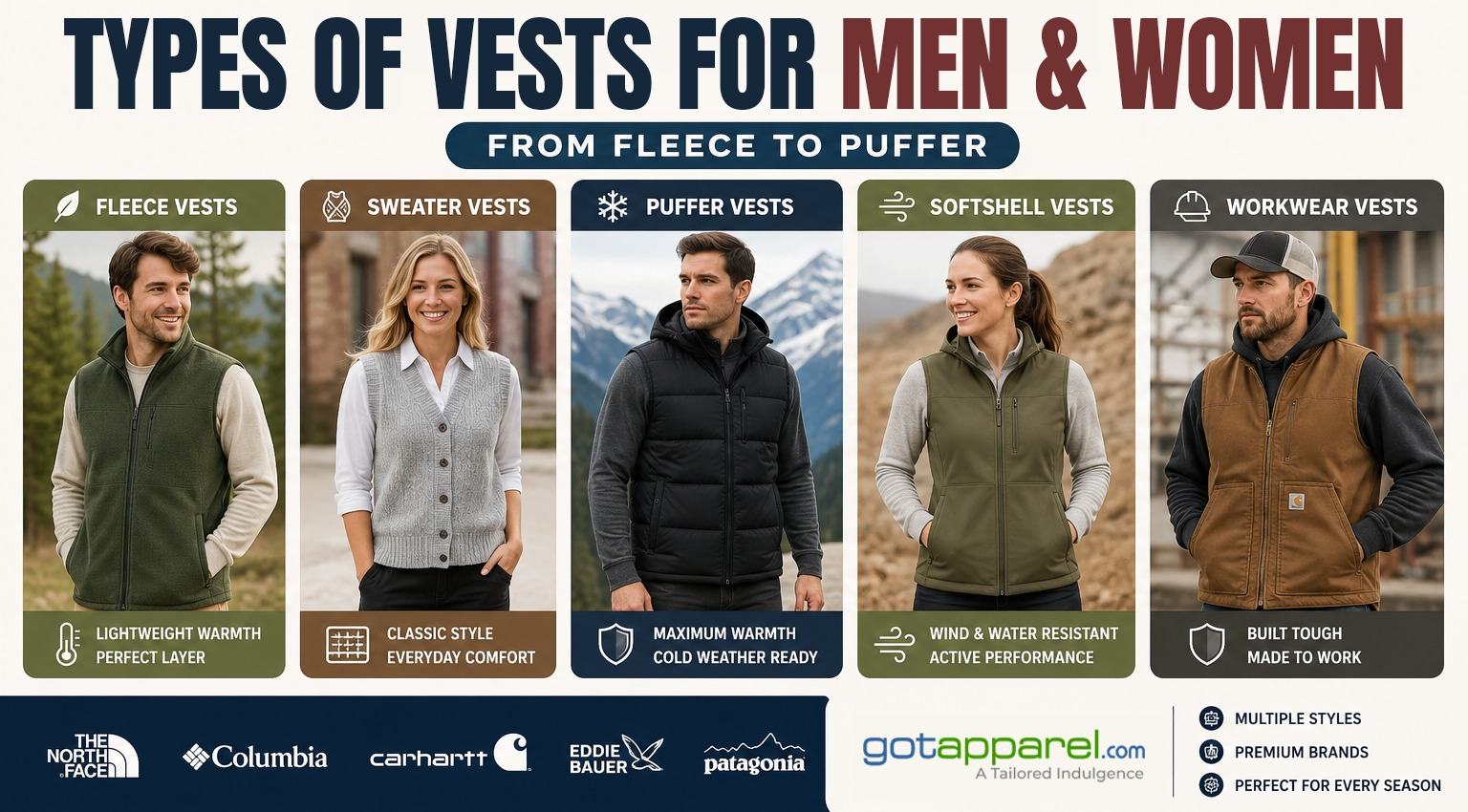
A vest solves a problem a jacket can’t — it keeps your core warm without trapping heat in your arms, which is exactly why it works jogging in October, sitting at a desk in a chilly office, or standing on a loading dock in March. At GotApparel we’ve been supplying vests to businesses, teams, and individual buyers for over 15 years, in constructions ranging from lightweight knit to insulated puffer to heavy-duty workwear canvas. This guide covers what each style is actually built from, who it fits, and when to reach for it — whether you’re buying one for yourself or fifty for a team.
Quick reference — all styles covered in this guide: fleece vests, sweater vests, puffer and quilted vests, softshell vests, workwear vests, men’s and women’s fits.
Types of Fleece Vests
A basic fleece vest is brushed polyester — soft, breathable, warm without much weight, which is why it’s the everyday layering vest almost every catalog defaults to. Harriton’s M985 runs at 8 oz, heavy enough to work alone on a cool day without feeling bulky over a t-shirt.
Not every fleece vest stops there, though. Dri Duck’s Compass Vest blends the idea with a softshell exterior — a 4.5 oz “Smart Shell” construction that pairs a fleece-soft interior with a more wind-resistant outer layer, so it sits between a plain fleece vest and a true softshell in what it can handle. If you want fleece’s comfort but you’re not always indoors, that hybrid is worth knowing exists before defaulting to the basic version.
Types of Sweater Vests
A sweater vest is knit rather than woven — pullover construction, ribbed trim at the neck and armholes, no zipper. Port Authority’s SW2860 is a clean example: meant to sit over a collared shirt, which is exactly where sweater vests show up most — offices, schools, anywhere a slightly more finished look matters more than raw warmth. It reads more formal than fleece and less bulky than a puffer, which is really the whole reason to reach for one instead of the other two.
Types of Puffer and Quilted Vests
A puffer vest uses a shell stitched into channels and filled with synthetic insulation, trapping air in small pockets for warmth without much weight. Port Authority’s J709 for men and L709 for women share the same quilted build on both sides — worth knowing if you’re outfitting a mixed-gender team and want the vests to actually match rather than approximate each other.
Spyder’s S16642 Pelmo Puffer Vest takes the construction further — a detachable hood with a bungee cord, and a concealed zipper inside the chest specifically built for embroidery access, so a logo can sit cleanly on the outer shell without the zipper pull interrupting it. That’s a small detail, but it’s the kind of thing that matters if a puffer vest is going into a branded program rather than personal use.
Types of Softshell Vests
A softshell vest is more structured than fleece or puffer — a woven, wind-resistant shell, sometimes with a bit of stretch, built to handle wind and light moisture better than a knit or quilted construction can. Port Authority’s J355 Challenger Vest fits here — a more technical, outdoor-oriented build for genuinely variable weather, where a fleece vest would leave you cold the second the wind picked up.
Types of Workwear Vests
This is the category most style guides skip entirely, and it’s a real gap — a workwear vest isn’t built for comfort layering, it’s built to survive a job site. CornerStone’s CSV40 Washed Duck Cloth Vest uses a 12 oz cotton duck cloth shell over a quilted 6 oz polyfill lining, with metal rivets at the stress points and a tailored length that clears a tool belt rather than bunching against it. It even has a dedicated pocket built for embroidery access, which tells you this vest was designed with branded uniform programs in mind from the start, not adapted for it after the fact.
If your team needs something that can take daily abuse — construction, landscaping, warehouse work — this is a different tier from anything in the fleece or puffer categories above, and worth choosing on durability first, style second.
Men’s and Women’s Vest Fits — What Actually Changes
Men’s vests generally run in a straight, boxy cut — room enough to layer a sweater or flannel underneath without pulling across the shoulders. Fit differences between brands mostly show up in armhole depth and overall length, so a Harriton fleece vest and a Port Authority softshell won’t necessarily match even in the “same” labeled size.
Women’s vests aren’t a smaller version of the men’s cut. Port Authority’s L219 Value Fleece Vest and L226 Microfleece Vest are both tailored through the waist with a shorter body and narrower shoulders than their men’s counterparts, and Core 365’s 78191 Journey Fleece Vest follows the same contoured logic. This is really what “women’s vests” means as a category — not a different garment, but a genuinely different cut, which is why ordering the women’s-specific style gets a noticeably better result than sizing down from men’s.
Vest vs Jacket — The Actual Difference
The distinction is simpler than it sounds: a jacket has sleeves, a vest doesn’t. Insulation type, shell fabric, formality — all of that can be identical between a vest and a jacket from the same line.
What actually decides which one you want is arm mobility versus arm warmth. A vest keeps your torso warm while leaving your arms completely free, which is why it layers so easily over a long-sleeve shirt or under a jacket without adding bulk. A jacket protects your arms too, at the cost of being warmer overall and less breathable during active movement. If you’re working with your hands or layering over something else, a vest usually wins. If you’re outside in genuinely cold or wet conditions with nothing else protecting your arms, a jacket is the better call.
Custom and Branded Vests — What Actually Works for Decoration
Fleece and softshell take embroidery cleanly on the left chest — the surface is flat and stable enough that stitching doesn’t distort. Puffer and quilted vests are trickier: the quilted channels can pucker around dense stitching, which is exactly why brands like Spyder and CornerStone build a concealed or dedicated chest pocket specifically to give embroidery clean, flat access despite the quilting underneath — a detail worth checking for before ordering a puffer vest for a logo program, since not every puffer style has it.
Screen printing works better on sweater vests and fleece than on puffer vests, where the quilted texture can distort a printed design. For workwear vests like the CornerStone CSV40, embroidery is the standard — the heavier canvas holds stitching well and looks more intentional on a durability-first garment than a printed logo would.
How to Choose a Vest — By What You’re Actually Doing
- Everyday layering over a t-shirt or button-down: A fleece vest like the Harriton M985 covers most situations without needing anything more specialized.
- Office or business-casual settings: A sweater vest like the Port Authority SW286 reads more polished than fleece without going as far as a full sweater.
- Outdoor work or unpredictable weather: A softshell vest like the Port Authority J355 Challenger handles wind and light moisture better than fleece or puffer alone.
- Genuine cold-weather warmth: A puffer vest —Port Authority J709 for men, L709 for women, or the Spyder S16642 if embroidery access matters — gives real insulation without a full jacket’s weight.
- Job sites and daily heavy wear: A workwear vest like the CornerStone CSV40 is built for exactly this, where a lifestyle fleece vest would wear out fast.
- Corporate uniform or team programs: Matching men’s and women’s pairs — J709/L709, or the fleece lineup across Harriton and Core 365 — keep a mixed-gender team coordinated, and fleece specifically takes embroidered logos cleanly.
- Individual gift or personal purchase: A sweater or fleece vest in a neutral color works across the widest range of situations if you’re buying just one.
Formal Vests and Safety Vests — Where to Look Instead
Not every vest belongs in this guide. A waistcoat, sometimes called a tuxedo vest, is the formal, tailored vest worn under a suit or tuxedo jacket, typically with a five- or six-button front and a cinched back — GotApparel lineup is built around casual, workwear, and layering vests rather than formalwear, so a dedicated formalwear supplier is the better source for that.
A safety vest is a different category entirely — high-visibility, reflective, built to ANSI/ISEA 107 compliance for construction, roadwork, and warehouse environments. We’ve covered exactly what class you need and how to brand one without breaking compliance in our dedicated high-visibility apparel guide.
Frequently Asked Questions
How many types of vests are there?
The categories most people actually need are fleece vest, sweater, puffer/quilted, softshell, and heavy-duty workwear vests, plus separate categories for formal vests (waistcoats) and safety vests. Most buyers only need one or two of these depending on climate and use case.
What are the different classes of vests?
Vests generally split into three groups — tailored/formal (waistcoats), casual/outerwear (fleece, sweater, puffer, softshell), and functional/utility (workwear, safety). GotApparel’s catalog covers the casual/outerwear and workwear groups, which handle the vast majority of everyday and team-program use cases.
What are the fancy vests called?
A formal vest is called a waistcoat, or a tuxedo vest specifically under a tuxedo jacket — tailored, five- or six-button, built to match a suit. A different category entirely from the layering and workwear vests covered here.
What are female vests called?
There isn’t a separate name — they’re women’s vests, built with a contoured waist, narrower shoulders, and a shorter body than the men’s equivalent. Port Authority’s L219, L226, and L709 are examples.
What’s the difference between a vest and a gilet?
Gilet is the British English term for the same garment — sleeveless, whether fleece vest, puffer, or softshell. Naming difference, not a design one.
Can vests be embroidered or logo’d?
Yes — fleece and softshell take embroidery cleanest. Puffer vests can be embroidered too, but check for a concealed chest zipper or dedicated pocket, like Spyder’s S16642 or CornerStone’s CSV40 have, since the quilted surface otherwise puckers under dense stitching.
Where can I buy vests for my team or business?
GotApparel carries fleece vest, sweater, puffer, softshell, and workwear vests for men and women from Harriton, Port Authority, Core 365, Spyder, CornerStone, Dri Duck, and more, with no minimums on blank orders and free shipping over $199. Custom embroidery takes 7 to 10 business days to complete and deliver and is available through the decoration team at 1-866-217-1729.