
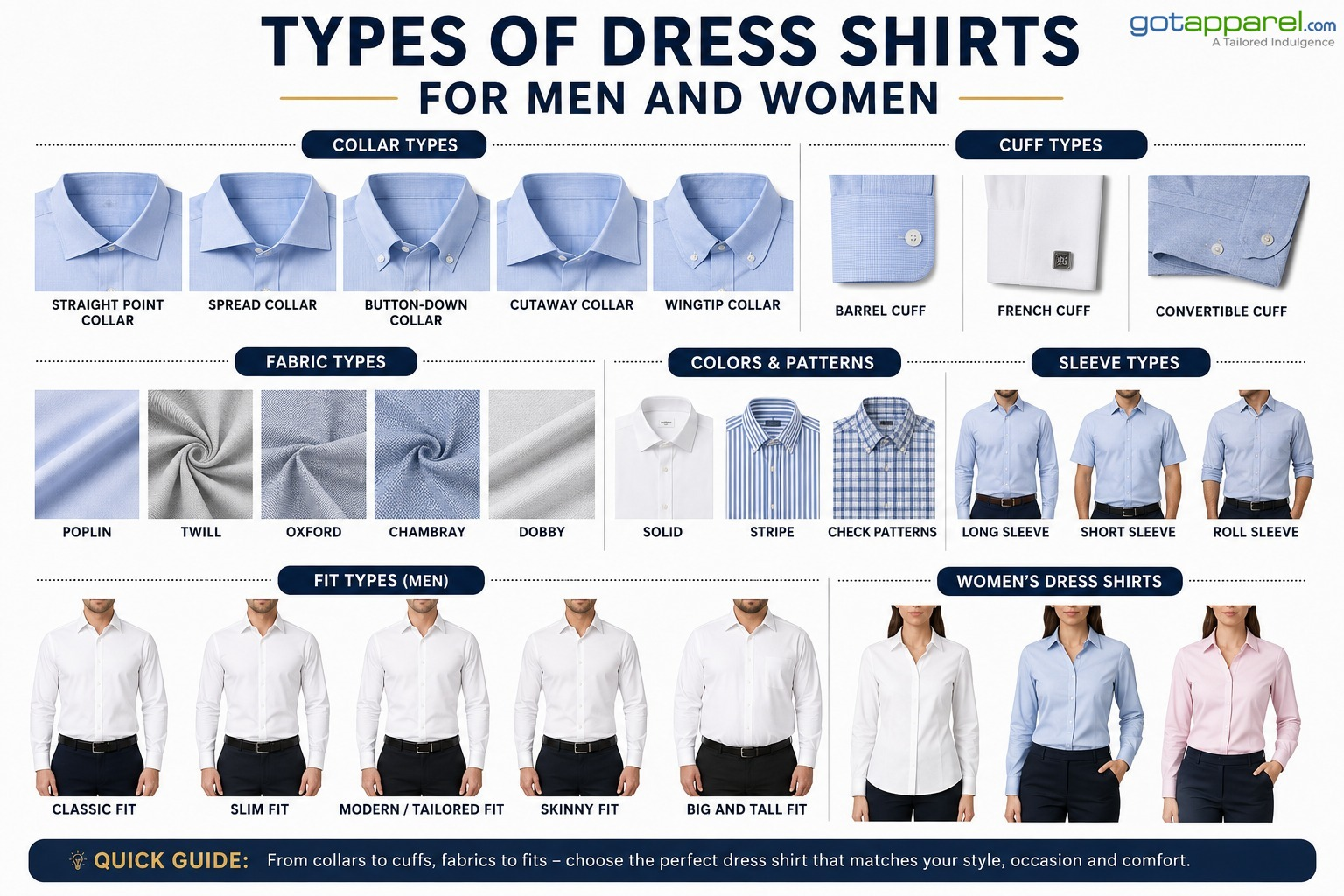
A dress shirt comes down to five decisions, whether you realize you’re making them or not — the collar, the cuff, the fabric, the pattern, and the fit. Get the collar right but pair it with the wrong fabric and the shirt reads business-casual instead of formal. Get the fit right but skip the fabric weight and it wrinkles by lunch. At GotApparel we have been supplying dress shirts to corporate programs, hospitality teams, and uniform buyers across the US for over 15 years. This guide breaks down every major type by what actually distinguishes one from another, with specific wholesale brand examples and weights worth knowing before you order.
Quick reference — all styles covered: straight point collar, spread collar, button-down collar, cutaway collar, wingtip collar, barrel cuff, French cuff, convertible cuff, poplin, twill, Oxford, chambray, dobby, solid, stripe and check patterns, long sleeve, short sleeve and roll sleeve, classic fit, slim fit, modern/tailored fit, skinny fit, big and tall fit, women’s dress shirts.
By Collar Style
Straight Point Collar
The straight point collar has points that sit close together and angle downward — the most common collar on wholesale dress shirts because it works with almost any tie knot and suits both formal and business-casual settings without forcing a decision about formality.
Spread Collar
A spread collar has points set wider apart, creating an open V that accommodates larger tie knots like a Windsor. The wider spread reads as more deliberate and formal than a straight point, which is why it shows up more in client-facing corporate programs. Without a tie the open gap can look unfinished, so this collar works best where a tie is part of the standard, not optional.
Button-Down Collar
A button-down collar has small buttons that fasten the collar points to the shirt body, keeping them in place with or without a tie. Harriton’s M510 Essential Poplin uses this collar with a structured collar stand and left-chest pocket — the fastened points hold their shape through a full workday rather than curling at the edges by mid-afternoon, which makes it the practical go-to for business-casual uniform programs.
Cutaway Collar
A cutaway collar pushes the spread angle further — the points sit almost horizontal, creating the widest possible opening at the neck. It only works comfortably with a substantial tie knot filling that space; without one it looks unfinished in a way the other collars don’t. Most wholesale uniform programs stay with straight point or button-down for practical reasons — the cutaway is a specialty choice rather than a daily uniform staple.
Wingtip Collar
A wingtip collar stands up stiffly with small folded tips at the front, built specifically for a bow tie and tuxedo. It belongs to formal eveningwear, not business uniforms, which is why it rarely appears in wholesale blank apparel catalogs at all.
By Cuff Type
Barrel Cuff
A barrel cuff is the standard dress shirt cuff — rounded or angled corners fastened by one or two buttons. It’s the practical default for daily wear and the cuff you’ll find on the majority of wholesale dress shirts including Harriton’s M500 Easy Blend Twill line.
French Cuff
A French cuff folds back on itself, doubling the fabric, and fastens with cufflinks instead of buttons. It’s a noticeably more formal choice — a deliberate signal rather than a default — and shows up most in executive programs and client-facing roles where the shirt is meant to communicate more than basic professionalism.
Convertible Cuff
A convertible cuff works either way — standard buttons for everyday wear, or cufflinks when the occasion calls for it. That flexibility makes it the practical choice for anyone moving between casual and client-facing settings on the same day without changing shirts.
By Fabric Weave
Poplin
Poplin is a tightly woven, lightweight fabric with a smooth, flat finish — the most formal and most common dress shirt fabric in wholesale programs. Harriton’s M510 Essential Poplin runs at 3.1 oz, light enough for warm climates and smooth enough to press into a sharp daily appearance. That flat surface also takes embroidery cleanly on the left chest, which is a big part of why poplin ends up as the standard for corporate logo programs.
Twill
Twill has a visible diagonal weave that gives it more texture and a heavier hand than poplin. Harriton’s M500 Easy Blend Twill runs at 4.6 oz in a 55/45 cotton-polyester construction with wrinkle-resistant and stain-release finishes built in. Port Authority’s S638 Non-Iron Twill takes a different approach to the same end result — 100% cotton built from 40-singles compacted yarn with a factory-applied non-iron finish so it comes out of the dryer ready to wear. Red House’s RH78 Non-Iron Twill offers the same non-iron convenience with superior color retention, which is worth noting for programs where shirt colors need to stay consistent across a long uniform lifecycle.
For a deeper comparison of twill specifically against denim shirting, GotApparel’s twill vs denim guide covers that decision in detail — this section focuses on twill against the other dress shirt fabrics, not the twill-versus-denim question.
Oxford
Oxford uses a basketweave construction that’s slightly heavier and softer to the touch than poplin, with a casual texture that reads as business-casual rather than formal. Port Authority’s S608 Long Sleeve Easy Care Shirt brings wrinkle and color-fade resistance to the Oxford-style category — a practical choice for programs where easy laundering matters as much as appearance.
Chambray
Chambray is a lightweight plain weave that looks similar to denim but is noticeably lighter and more breathable — strictly casual in its register, never formal. It’s woven with a colored yarn in one direction and white in the other, which gives chambray its soft, slightly faded look even when brand new.
Dobby
Dobby uses a specialized loom to weave small geometric patterns directly into the fabric rather than printing them on. Devon & Jones’ DG532 Royal Dobby Shirt runs at 3.9 oz in a 60/40 cotton-polyester blend with built-in wrinkle-free and stain-release performance — straight from the dryer, no ironing required. Red House’s RH76 Non-Iron Diamond Dobby adds a different geometric pattern in a similarly low-maintenance construction. Both are a quiet step up in visual interest from a plain weave without crossing into a bold pattern, which makes them a practical upgrade for programs that want the shirt to look a little more considered without adding care complexity.
Patterns — Solid, Stripe and Check
Pattern is a separate decision from fabric weave, and it’s where most dress shirt guides stop short. A solid shirt in any of the fabrics above is the safest and most versatile choice — it works under any jacket, with any tie, in any setting. Devon & Jones’ D620 Classic Fit Solid Dress Shirt takes this baseline further with a true non-iron performance finish and stain-release treatment, so the simplest pattern option is also one of the most practical.
Stripes and checks are the next step up in visual interest. Devon & Jones‘ Crown Woven line covers both — a banker stripe and a gingham check built on the same non-iron, stain-release fabric as their solid options, which means a program can mix solids and patterns across a team without changing fabric weight or care instructions. Port Authority’s S654 Long Sleeve Gingham Easy Care Shirt gives the same check option at a slightly lower price point. Stripes read more formal than checks, generally — a fine banker stripe pairs naturally with a suit, while a gingham check sits more comfortably in business-casual territory.
Sleeve Styles
Long sleeve is the standard for formal and business settings — the full-length sleeve reads as intentional rather than casual in client-facing and professional environments. Short sleeve dress shirts exist and work well in warm climates and more relaxed uniform contexts, but they don’t carry the same formality signal as a long sleeve in an office or hospitality setting.
The detail that actually affects daily wear within long sleeve shirts is whether the construction includes a roll-sleeve feature. Port Authority’s S649 Stain-Release Roll Sleeve Twill Shirt includes a tab or button that holds the sleeve in place when folded to the forearm, rather than sliding back down throughout the day. For warm climates or active roles where sleeves get rolled up constantly, that small construction detail is worth checking for before ordering a large run.
By Fit
Classic Fit
Classic fit is cut full through the chest, waist, and arms — the most relaxed and most forgiving option across the widest range of body types. It’s the default for corporate uniform programs covering a full team because it doesn’t demand the sizing precision a closer fit needs to look right.
Slim Fit
Slim fit tapers through the chest, waist, and arms for a closer, more contemporary silhouette. It looks sharper on a leaner frame but raises the sizing stakes across a team order — a slim fit shirt that doesn’t fit correctly looks noticeably worse than a classic fit shirt in the same situation.
Modern/Tailored Fit
Modern or tailored fit sits between classic and slim — some contouring through the body without the full taper of a true slim fit. For programs that want a more polished look than classic fit without the sizing risk of slim, this is the practical middle ground.
Skinny Fit
Skinny fit is cut extremely close to the body throughout — through the chest, waist, and arms — for a tight, contemporary silhouette. It’s the most fashion-forward option on this list and the least practical for bulk uniform programs since it works well only for a narrow range of body types. For individual buyers who know their measurements precisely, it’s a deliberate style choice rather than a sizing variation.
Big and Tall Fit
Big and tall dress shirts extend both body length and chest width beyond standard sizing — built specifically for taller and larger frames rather than a standard cut in a larger size. Harriton’s M510T Tall Essential Poplin is a direct example: same 3.1 oz poplin as the standard M510, with extra body length built in for a proper tuck. Port Authority’s TLS638 Non-Iron Tall Twill gives the same tall-specific construction in a non-iron twill. This is one of the most consistently overlooked categories in dress shirt guides despite being a real, recurring need for any program covering a full team size range.
Dress Shirts for Women — Cuts and Considerations
Women’s dress shirts aren’t smaller versions of men’s styles — the construction itself is different. Port Authority’s L608 Long Sleeve Easy Care Shirt and L612 3/4-Sleeve Easy Care Shirt are built with a contoured cut through the waist, narrower shoulders, and the 3/4-sleeve option that has no real equivalent in most men’s lines. Harriton’s M500W Women’s Easy Blend Twill Shirt matches the men’s M500 in fabric and weight — same 4.6 oz, 55/45 cotton-polyester construction — cut specifically for women’s proportions rather than asking someone to size down from a men’s shirt.
Devon & Jones‘ women’s Crown Woven collection extends this logic into patterns — their gingham check and Royal Dobby women’s shirts match the men’s fabric constructions in weight and performance, cut for a women’s fit, so a mixed-gender team can order coordinated patterns from one brand line without sourcing across multiple suppliers. For programs ordering matching shirts across a full team, staying within one brand’s men’s and women’s equivalents keeps fabric, color, and care instructions consistent in a way that mixing brands rarely does.
How to Choose by Use Case
For a daily corporate uniform program where the whole team needs to match without individual tailoring, Harriton’s M510/M510W poplin pairing covers men’s and women’s from the same consistent fabric at 3.1 oz — light enough for year-round wear and smooth enough to press cleanly every time.
For programs where ironing is genuinely not going to happen, Port Authority’s S638 or Red House’s RH78 non-iron twill shirts are the practical answer — both come out of the dryer ready to wear without an iron touching them, which is a meaningful operational difference across a large uniform program.
For client-facing or executive roles where the shirt needs to signal more intention, a spread collar in dobby fabric like the Devon & Jones DG532 adds texture and polish without a bold pattern, and it does it in a non-iron construction that holds up to the daily wear those roles typically demand.
For embroidery programs, poplin and standard twill both take left-chest logos cleanly. A heavily textured Oxford can distort fine embroidery detail, so it’s worth testing on a sample before committing to a large embroidered run in that fabric.
For big and tall coverage, confirm a tall-specific cut like Harriton’s M510T or Port Authority’s TLS638 exists in your order rather than assuming a larger standard size will fix the fit — tall sizing corrects for body length, which a wider chest size alone doesn’t address.
For mixed-gender team orders, matching within one brand’s men’s and women’s equivalents — M500 and M500W, or L608 paired with its men’s counterpart S608 — keeps the team looking coordinated rather than approximate.
Frequently Asked Questions
What type of collar should I wear for a dress shirt?
Straight point works for most situations and tie knots — it’s the default on most wholesale dress shirts for that reason. Spread collar suits more formal settings and larger tie knots. Button-down is the practical choice for business-casual programs where the shirt needs to look finished with or without a tie.
What type of dress shirt should I wear with a suit?
A poplin or twill dress shirt in a spread or straight point collar is the standard pairing with a suit — spread collar accommodates the larger tie knots typically worn with a suit jacket, while straight point works with most standard knots.
What type of dress shirt uses cufflinks?
A French cuff dress shirt requires cufflinks — the doubled-back cuff construction has no buttonholes and fastens entirely through the cufflink. A convertible cuff can use cufflinks optionally but also works with standard buttons.
What type of undershirt should I wear with a dress shirt?
A lightweight, moisture-wicking crew or V-neck undershirt close to your skin tone works best — thin enough that it doesn’t add visible bulk under poplin or lightweight twill.
What is the difference between poplin and twill dress shirts?
Poplin is lighter and smoother, typically around 3 oz, and is the more formal standard for corporate dress shirts. Twill is heavier — Harriton’s M500 runs at 4.6 oz — with a visible diagonal weave that resists wrinkles better and holds its shape longer through a workday, though it reads as slightly less formal than poplin.
Where can I buy wholesale dress shirts for men and women?
GotApparel carries dress shirts from Harriton, Port Authority, Devon & Jones, Red House, and more in poplin, twill, Oxford, chambray, and dobby, including big and tall and women’s-specific cuts, with no minimums on blank orders. Free shipping over $199, same-day dispatch before 3pm EST. Browse at gotapparel.com or call 1-866-847-8678. Custom embroidery available through the decoration team at 1-866-217-1729.