
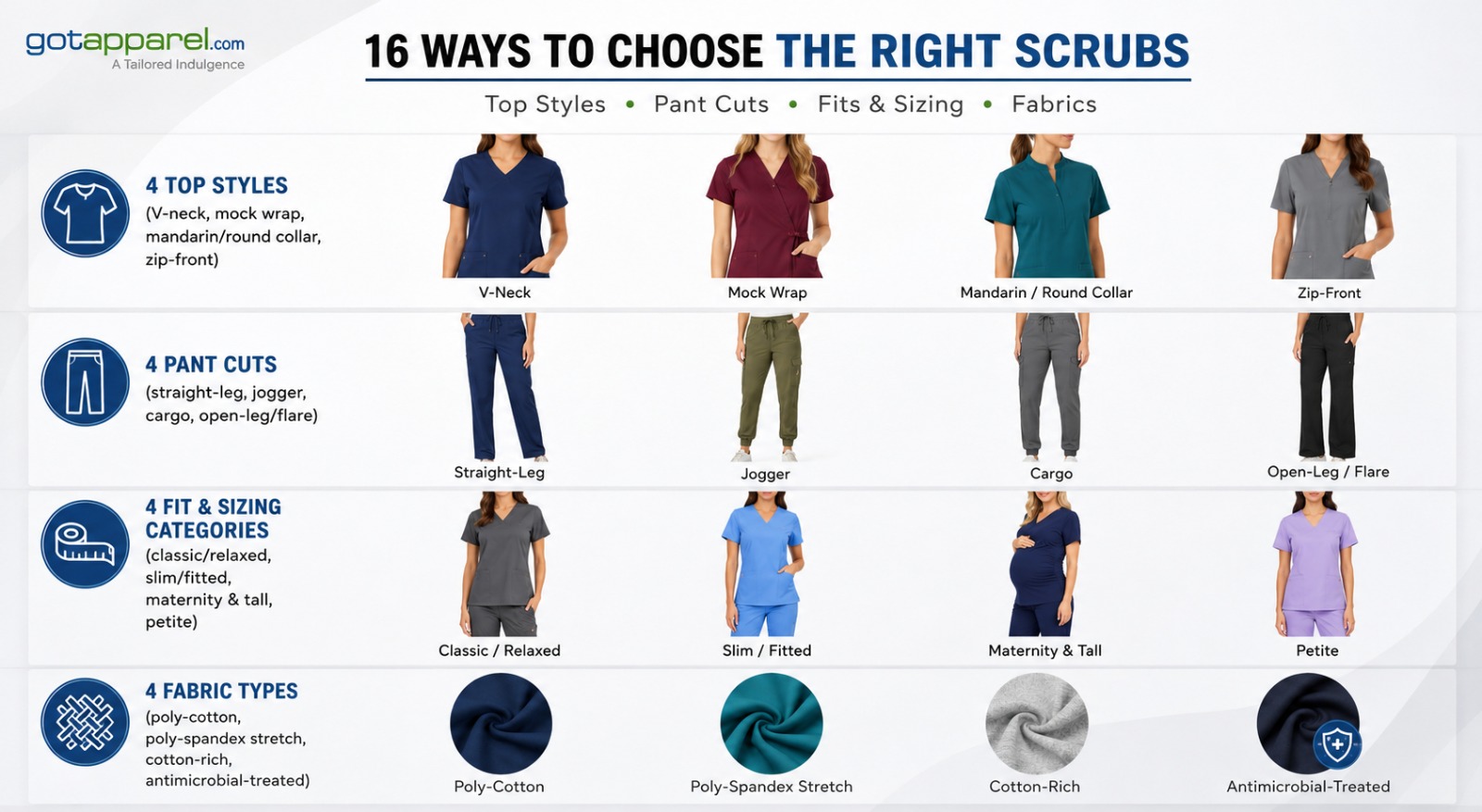
A scrub set that fits wrong or wears out in three months isn’t just uncomfortable — it’s a real cost, whether you’re one nurse buying your own or a hospital outfitting three hundred staff. This guide breaks scrubs down the way they actually get chosen: by top style, pant cut, fit and sizing, fabric, and even what the color means, so the decision comes down to what fits your shift, not just what’s on sale.
What this guide covers: scrub top styles, pant cuts, fit and sizing categories, fabric types, what scrub colors signal by department, wholesale buying, decoration, and a brand comparison.
How We Compare Scrub Styles
This guide compares scrubs using the details that actually matter once they’re being worn or ordered: fit, fabric, mobility, pocket configuration, sizing range, and intended use. Product examples come from the brands and styles carried through GotApparel’s own catalog, and fabric or construction details reflect current manufacturer information. Healthcare facilities often have their own uniform, color, or laundering requirements, so treat this as a buying reference and confirm any facility-specific rules before placing a larger order.
Types of Scrubs by Style
Before getting into tops and pants separately, it’s worth naming the broader categories these details fall under, since that’s usually the frame people are actually searching in. Traditional or classic scrubs prioritize loose fit and airflow over shape. Modern or fitted scrubs use added seams and stretch for a closer, more tailored look. Jogger and cargo scrubs are built around movement and storage rather than a specific silhouette. Performance or stretch scrubs use spandex-blend fabric for active roles. And maternity, tall, and petite scrubs adjust proportions rather than introducing a new style entirely. A single scrub set can belong to several of these at once — a jogger pant can also be a stretch fabric and a petite fit — which is exactly why the sections below split by category rather than trying to name one “type” per product.
Scrub Comparison at a Glance
| Style/Feature | Best For | Key Detail |
|---|---|---|
| V-neck top | General wear, most departments | Simple, layers easily |
| Mock wrap top | Fitted, tailored look | Crossover front panel |
| Mandarin/round collar | Patient-facing roles | Closer, polished neckline |
| Zip-front top | Frequent layering | On/off without pulling over head |
| Straight-leg pants | Maximum movement | No taper or cuff |
| Jogger pants | Standing/walking shifts | Elastic ankle cuff |
| Cargo pants | Carrying supplies | Utility leg pockets |
| Open-leg/flare pants | Traditional fit over shoes | Wider ankle opening |
| Antimicrobial-treated fabric | Odor/fabric hygiene | Treated to resist odor-causing microbes |
| Petite sizing | Shorter frame, proportional fit | Shortened rise and inseam |
Scrub Top Styles
V-Neck Tops
The V-neck is one of the most common scrub tops for a reason — it’s simple, it layers easily over an undershirt, and it works across nearly every department without looking out of place. The Onna NN310 Women’s Invincible V-Neck Stretch uses stretch fabric designed to provide flexibility and ease of movement during a full shift, and the Jaanuu M10001 Men’s Holmes Everyday 1-Pocket Scrub V-Neck adds a chest pocket, a small but genuinely useful detail for anyone who carries a badge, pen, or other small essentials during a shift. The Hanes HSB002 Women’s V-Neck 3 Pocket Scrub Top offers a more budget-friendly option with extra pocket storage, and customer reviews on this style frequently mention comfort and fit.
Mock Wrap Tops
A mock wrap top uses a crossover front panel instead of a straight neckline, which gives a more tailored, fitted look without sacrificing the pull-over-the-head simplicity of a standard scrub top. It’s become popular specifically with staff who find a plain V-neck too boxy but don’t want actual wrap-front buttons or ties to deal with mid-shift.
Mandarin and Round Collar Tops
A mandarin or round collar sits closer to the neck than a V-neck, giving a cleaner, slightly more polished line — a detail some facilities specify for front-desk or patient-facing roles where the scrub top doubles as the first thing a patient sees.
Zip-Front Tops
A zip-front scrub top works like a light jacket rather than a pullover, which matters most for staff who need to put it on and take it off repeatedly through a shift — checking a badge, adjusting layers between a cold OR and a warmer hallway. It’s a smaller category than the other three, but a genuinely useful one for anyone layering constantly.
Scrub Pant Cuts
Straight-Leg Pants
A straight-leg cut is the traditional, roomy scrub pant silhouette — no taper, no elastic cuff, built for maximum ease of movement rather than a fitted look. The Jaanuu M20001 Men’s Rhodes Everyday Straight-Leg Scrub Pants are a solid, no-frills example of this classic cut.
Jogger Pants
Jogger-style scrub pants add an elastic or rib-knit ankle cuff to a tapered leg, which keeps fabric from bunching around the ankle during a long shift on your feet. The Onna NN610 Women’s Energized Stretch Jogger uses this cut, and the Hanes HMB001 Men’s Scrub Joggers brings the same silhouette to a more budget-friendly price point — customer reviews on the Hanes version frequently mention comfort during long shifts.
Cargo Pants
Cargo-style scrub pants add utility pockets on the legs, which matters most for staff who carry more than a phone and a badge — trauma nurses, EMTs, or anyone who needs quick access to supplies without returning to a station. The Onna NN500 and NN600 build this feature into a stretch fabric base for men’s and women’s fits respectively, and the Jaanuu M20002 Osmo takes it further with an 8-pocket layout for staff who need serious on-the-go storage.
Open-Leg and Flare Pants
An open-leg or slightly flared cut sits wider at the ankle than a jogger, letting the pant fall over a shoe rather than cinching at the cuff. The Hanes HMB003 and HSB003 represent this more traditional cut for men and women, and customer reviews on both styles frequently mention comfort.
Fit and Special Sizing Categories
Classic and Relaxed Fit
A classic or relaxed fit prioritizes airflow and unrestricted movement over a tailored shape — the boxier cut many hospitals still default to for exactly that reason, since it accommodates a wider range of body types without needing multiple fit categories.
Slim and Fitted Fit
A slim or fitted cut uses princess seams or added stretch to follow the body’s shape more closely, which reads more polished and modern but requires more precise sizing than a relaxed cut. The Onna stretch lines lean into this fit specifically, built for staff who want scrubs that don’t look shapeless under a lab coat.
Maternity and Tall Sizing
Maternity scrubs build in extra room through the belly and hips without needing an entirely separate style, while tall sizing extends inseam and torso length for staff who find standard sizing runs short. Both matter more in bulk ordering than individual shopping, since a facility outfitting a full staff needs to cover this range without guessing.
Petite Sizing
Petite scrubs shorten the rise and inseam proportionally rather than just sizing down, which keeps the fit balanced rather than leaving extra fabric pooling at the ankle. The Jaanuu W20001P, W20003P, and W40001P lines all offer petite versions of their standard women’s pants, which is a genuinely useful detail for facilities with a size-diverse staff to outfit.
Fabric and Fiber Guide
- Poly-cotton blends — the traditional scrub fabric, durable and breathable, though prone to wrinkling more than a synthetic-heavy blend
- Poly-spandex stretch blends — a popular choice for active roles, providing flexibility through bending, lifting, and movement
- Cotton-rich blends — softer against the skin, better for staff with sensitive skin or long shifts in warmer climates
- Antimicrobial-treated fabric — chemically treated to resist odor-causing microbes on the garment itself
Some Jaanuu scrub styles use a Silvadur antimicrobial finish, which is a real, named technology rather than a vague “odor-resistant” marketing claim. Worth being clear on what this actually does: an antimicrobial finish helps manage odor buildup on the fabric, but it isn’t a substitute for standard laundering or a facility’s actual infection-control protocols — it’s a fabric feature, not a clinical safeguard.
What Scrub Colors Actually Mean
Scrub color often isn’t arbitrary in hospitals — many facilities use specific colors to identify departments or roles at a glance, which matters in a fast-moving clinical environment where a patient or visitor needs to quickly tell a surgeon from a nurse from support staff. Ceil blue and navy are common general-staff defaults in the industry, though the exact color names and availability vary by manufacturer and specific product line.
The reason surgical scrubs traditionally run green or blue rather than white comes down to a few practical factors working together, not one single rule. Green and blue offer visual contrast against a red surgical field and can reduce the distracting afterimage effect that comes from staring at red for extended periods. Both colors can also reduce visual glare under bright surgical lighting and make stains less visually prominent than white — a combination of reasons, not just one, which is why the convention has held up across decades of changing fabric and design trends.
Matching Scrubs to Your Role
For nurses working long, active shifts, mobility, breathable fabric, and pocket placement usually matter more than a tailored silhouette — a jogger cut or stretch fabric earns its keep here. For physicians moving between clinical and administrative settings, a cleaner, more structured fit like a mandarin collar or slim cut often reads better across both environments. For surgical teams, fabric performance and how well a garment survives high-heat industrial laundering typically take priority over style, since these scrubs go through the most frequent, most demanding wash cycles of any role.
What to Check Before Ordering
Check the actual size chart for the specific style you’re ordering rather than relying on your usual clothing size, since fit varies meaningfully between a classic cut and a slim or stretch style. A desk-based role may prioritize comfort and easy layering, while a physically active role may benefit more from stretch, mobility, and secure pocket storage — worth matching fabric choice to how the role actually moves through a shift. If you’re ordering for a facility, confirm any specific color, style, or laundering requirements before placing a larger order, since those rules vary by employer and aren’t universal across healthcare settings.
Buying Scrubs Wholesale
Blank scrub styles carry no minimum order, so a single top or pant set prices the same per unit as a larger facility order. Per-unit pricing improves as order size increases, and sizing across the Jaanuu, Onna, and Hanes lines here runs from petite through tall and maternity, giving facilities more options when outfitting staff across different sizes and fits without having to split an order across multiple suppliers.
Decorating Scrubs — Embroidery and Screen Printing
Embroidery is a common choice for scrub decoration because a stitched logo can hold up well through repeated washing and laundering. Screen printing works on flatter poly-cotton fabric but wears faster under the frequent, high-heat washing many facilities use for infection control, so it’s a better fit for lower-wash-frequency items. A 6-piece minimum applies to custom decoration orders, mixable across styles and sizes at GotApparel with free shipping in the US over $199.
Brand Comparison for Scrubs
| Brand | Known For | Best For |
|---|---|---|
| Jaanuu | Antimicrobial fabric, petite sizing, wide style range | Facilities prioritizing fabric hygiene and fit range |
| Onna | Stretch cargo and jogger cuts | Active roles needing pocket storage and mobility |
| Hanes | Budget-friendly tops, joggers, and open-leg pants | Everyday staff scrubs, high-volume ordering |
| CornerStone | Reversible scrub pants | Simplified color-matching across a large staff |
Frequently Asked Questions
What are the most popular scrubs?
V-neck tops paired with straight-leg or jogger pants are among the most versatile combinations, since they work across a wide range of body types, departments, and shift environments.
What color scrubs does each department wear?
Color conventions vary by facility, but ceil blue and navy are common general-staff defaults, while surgical teams traditionally wear green or blue for a mix of practical reasons — better contrast against blood, less glare under bright lighting, and reduced visual afterimage from prolonged exposure to red.
What are the different types of medical scrubs?
Medical scrubs break down by top style (V-neck, mock wrap, mandarin collar, zip-front), pant cut (straight-leg, jogger, cargo, open-leg), and fit category (classic, slim, maternity, tall, petite), with fabric choice layered on top of all three.
Why do surgeons not wear white scrubs?
Green and blue offer better contrast against blood, reduce glare under bright surgical lighting, and make stains less visually prominent than white — a combination of practical reasons rather than a single rule.
How should scrubs be washed to maintain fabric quality?
Follow the care label for the specific scrub style, since washing instructions vary by fabric and finish. In general, repeated high-heat drying can put more stress on stretch fibers and some specialty finishes, so lower-heat drying is often preferable when the manufacturer’s instructions allow it.
Whether it’s one set for a new hire or a full staff order spanning petite to tall, the right scrubs come down to matching cut, fit, and fabric to the actual shift — not just picking whatever’s cheapest. Reach our support team at support@gotapparel.com or 1-866-847-8678, or the decoration team at decoration@gotapparel.com / 1-866-217-1729.